




Communication Manager
Experts

Ana Krstinovska
Research Fellow, Wider Europe Programme, foreign policy, international relations, contemporary China and EU-China-Western Balkans relations

Frauke M. Seebass
Research Fellow, Wider Europe Programme, Brussels
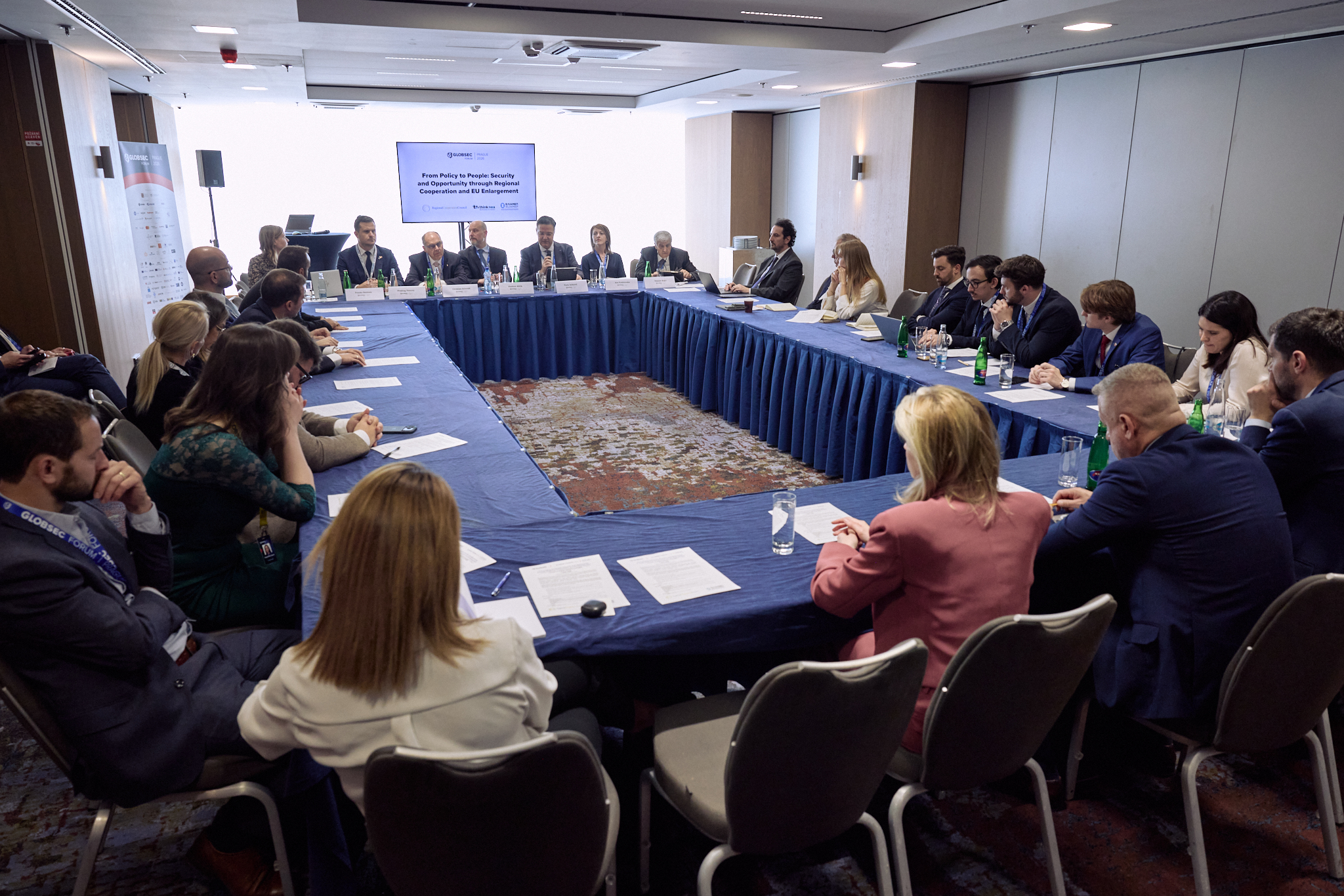
In this year’s GLOBSEC Forum, the Hellenic Foundation for European & Foreign Policy (ELIAMEP) co-organised with the Regional Cooperation Council (RCC) the side session titled “From Policy to People: Security and Opportunity through Regional Cooperation and EU Enlargement” which was moderated by Vladimír Bilčík (Senior Fellow, GLOBSEC). Pavle Janković (Head of the Political Department, Regional Cooperation Council) made the introductory remarks.
In her intervention, Dr. Ana Krstinovska (Senior Researcher, think nea – New Narratives of EU Integration; Research Fellow, Wider Europe Programme – ELIAMEP) introduced the work of ELIAMEP’s pioneering initiative think nea – New Narratives of EU Integration (supported by OSF WB) and outlined three possible scenarios for the future of EU enlargement in the Western Balkans. If the EU succeeds in integrating all Western Balkan countries within the next ten years, it would significantly strengthen the Union’s credibility and reinforce its role as a global actor. This would be the ideal scenario; however, achieving it would require the EU to step up its efforts by addressing the concerns of current member states and resolving bilateral disputes. A second scenario, in which only Montenegro and Albania join the EU, would still send a positive signal, but it could also create new dividing lines within the region. In the worst-case scenario, none of the Western Balkan countries would join the EU over the next decade. This would have detrimental consequences not only for the countries themselves, but also for the EU’s credibility and strategic position, while benefitting systemic rivals. Failure to advance enlargement would further undermine the EU’s influence in the region, increase potential security risks, and prolong the costs of missed opportunities in areas such as defence readiness and supply chain resilience. While there is currently a window of opportunity for the Western Balkans’ accession, there is also a strategic opportunity for the EU to preserve its influence in the region and maintain its relevance amid growing geopolitical competition.
Following up on this, Frauke Seebass (Researcher, think nea – New Narratives of EU Integration; Research Fellow, Wider Europe Programme – ELIAMEP) presented ELIAMEP’s Defense Hub and its scope of work and then she echoed Roberta Metsola’s remarks from the previous day that the EU cannot afford to miss the opportunities a closer integration of the Western Balkans present. Indeed, in many of the areas relevant for the EU’s goal of strategic autonomy such as defense capacities and critical raw materials (CRM), the key investors are non-EU (chiefly China, Türkiye, US). The EU needs to scale up much beyond the traditional enlargement methodology to unlock the mutual benefits and directly involve the countries in existing and emerging policies and structures.
Christian Schmidt (High Representative for Bosnia and Herzegovina) emphasised the urgency of the EU to engage meaningfully with the country in view of the new US approach to the region, putting in question the “pax americana” following the post-Yugoslav wars. For Bosnia and Herzegovina itself, the EU path remains blocked – in the absence of relevant reforms, it did not manage to unlock the funds under the EU Growth Plan, nor to start accession negotiations which have been on the table since 2023. If the EU is serious about integrating the country, it must be much more present and creative.
Professor Hüseyin Bağcı (Professor, Middle East Technical University) warned that the current EU approach to enlargement was not sufficient to further the bloc’s interests in the field of strategic autonomy in which the Western Balkans continue to be sidelined. He pointed to the presence of other actors in the region and the potential threat to the EU as a whole given the existing deep connections.
Finally, Dr. Predrag Zenović (Chief Negotiator of Montenegro) emphasized the importance of showing that the enlargement process works, both for the region and for the EU itself. He made it clear that while the process has a new geopolitical drive since Russia’s full-scale invasion of Ukraine, Montenegro does not get any discounts. For regional cooperation, he pointed to the importance of preserving diversity while finding common ground, keeping human rights and human dignity always at the centre of the debate. Montenegro will be hosting the Berlin Process and the EU Western Balkans Summit this year.
 Projects