


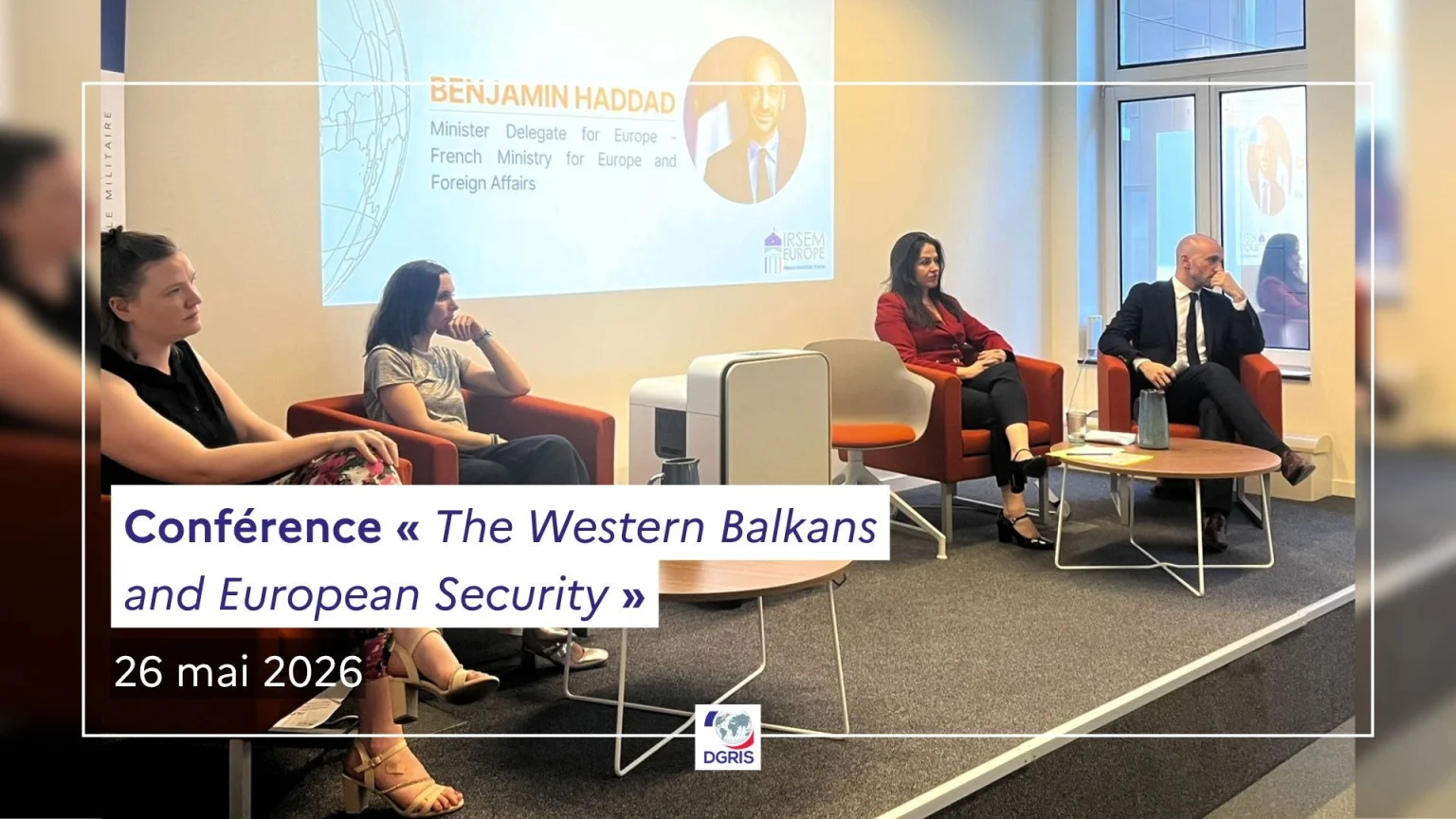

On the 26th of May, IRSEM organized the conference “Western Balkans and European Security: Enlargement as a Strategic Imperative” in Brussels. ELIAMEP’s Frauke Seebass, Research Fellow, Wider Europe Programme – ELIAMEP & think nea, New Narratives of EU Integration, was one of the speakers alongside Filip Ejdus, Director of the Centre for International Studies and Professor of Security Studies at the Faculty of Political Science, University of Belgrade, Tefta Kelmendi, Associate Researcher at the Jacques Delors Institute), Iliriana Gjoni (Political Analyst at Carnegie Europe.
Closing remarks were made by Benjamin Haddad, French Minister Delegate for Europe, while the discussion was moderated by Philippe Perchoc, Director IRSEM Europe.
The main points that were discussed focused on the growing security dimension of EU enlargement and the changing role of the Western Balkans in European security architecture. Participants emphasised that Western Balkan countries should increasingly be seen as contributors rather than consumers of security, not only through defence structures such as NATO but also through their importance for regional connectivity and geopolitical stability. Enlargement and security were described as historically interconnected, with stability, strategic alignment, and improved governance becoming even more important in the current geopolitical context marked by transatlantic tensions and increasing defence spending needs.
In this regard, the conditionality principle was considered essential. Several speakers argued that the EU must change its narrative towards the region and avoid acting as another transactional actor focused on appeasing “stabilitocrats.” Instead, defence cooperation should be used as a tool for integration, including through regional cooperation on procurement, training, and preparedness, especially as actors such as China, the United States, and Türkiye continue to expand their influence in the region.
Benjamin Haddad emphasised that the security dimension of enlargement has become increasingly important and argued that Europe can no longer afford “grey zones” vulnerable to foreign interference. He stressed that Europeans are increasingly taking responsibility for their own security, including in the wider neighbourhood, and highlighted the European Political Community as an important platform for strategic communication among political elites. According to Haddad, the EU must pursue a threefold approach: first, it must transform internally in order to build greater resilience without delaying enlargement; second, it must become more sovereign and capable of countering foreign influence and transnational organised crime; and third, it must engage more actively in unresolved local and bilateral disputes, including those involving member states such as Bulgaria and North Macedonia. He also underlined that the Western Balkans are already making meaningful contributions to European security, citing Montenegro’s cyber security centre as an example, and stressed the importance of strengthening local ownership across the region.
Δημοσίευση:
28/05/2026
 Έργα
Αναλυτές
Έργα
Αναλυτές

Frauke M. Seebass
Research Fellow, Wider Europe Programme, Brussels