


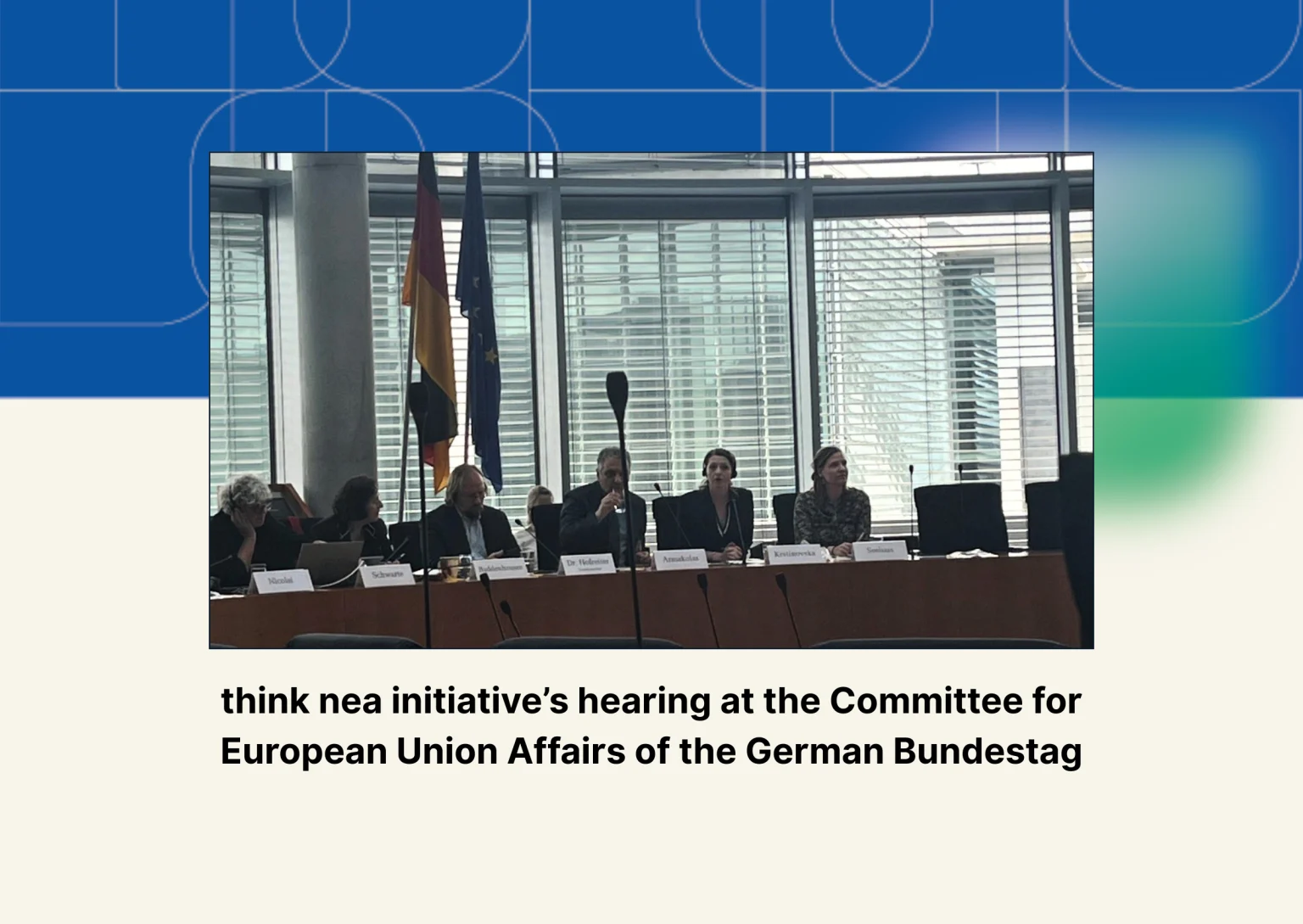

In the framework of a recent visit in Berlin, representatives of ELIAMEP’s initiative think nea – New Narratives of EU Integration were invited to contribute to a closed-door hearing of the Committee on European Union Affairs of the German Bundestag in Berlin on 10 June. The session at the German Federal Parliament lasted for one hour.
Dr. Ioannis Armakolas, Director, think nea – New Narratives of EU Integration & Head, Wider Europe Programme – ELIAMEP, Dr. Ana Krstinovska, Senior Researcher, think nea – New Narratives of EU Integration & Research Fellow, Wider Europe Programme – ELIAMEP, and Dr. Frauke Seebass, Research Fellow, think nea – New Narratives of EU Integration & Wider Europe Programme – ELIAMEP presented the core arguments, research findings about the initiative which contributes to reimagining the EU’s engagement with the Western Balkans, as well as the region’s contributions to European strategic autonomy in order to ensure a resilient EU integration strategy and ever-closer integration with a full membership perspective in mind.
Following introductory remarks by Dr. Ioannis Armakolas, Dr. Ana Krstinovska delivered the opening intervention based on the initiative’s pioneering research findings, which frame EU enlargement and European strategic autonomy as increasingly interconnected policy agendas.
In her intervention, Dr. Krstinovska argued that the Western Balkans should no longer be viewed solely through the lens of accession but also as contributors to Europe’s defence readiness, industrial resilience and economic security. Highlighting the region’s defence manufacturing capacities, strategic raw materials and integration into European supply chains, she stressed that strengthening ties with the Western Balkans is not only a matter of completing European unification but also of advancing Europe’s ability to remain secure, competitive and sovereign in an increasingly fragmented geopolitical environment.
In response to questions from German parliamentarians, the think nea delegation further elaborated on the initiative’s research findings and policy recommendations regarding the future of EU enlargement and the role of the Western Balkans in Europe’s evolving strategic landscape. Particular emphasis was placed on the growing interconnection between enlargement policy and European strategic autonomy, as well as on the strategic value of integrating candidate countries more closely into key European policy frameworks.
The think nea team also highlighted the importance of maintaining a credible enlargement process while exploring avenues for deeper sectoral cooperation and gradual integration. Drawing on the initiative’s research, they underlined the Western Balkans’ potential contribution to European defence capabilities, supply-chain resilience, industrial development and economic security. The discussion further reflected on the broader geopolitical context shaping enlargement policy and the importance of strengthening Europe’s capacity to act as a secure, competitive and resilient global actor.
The hearing provided an important opportunity to present think nea’s latest research findings and engage with German politicians and officials on the future of EU enlargement and European strategic autonomy. More broadly, it enabled a discussion of how the Western Balkans can contribute to Europe’s security, competitiveness, resilience and strategic autonomy in an increasingly uncertain international environment, while reinforcing the importance of a credible and forward-looking enlargement policy.
Δημοσίευση:
24/06/2026
 Έργα
Αναλυτές
Έργα
Αναλυτές

Ioannis Armakolas
Head of the Wider Europe Programme; Senior Research Fellow

Ana Krstinovska
Research Fellow, Wider Europe Programme, foreign policy, international relations, contemporary China and EU-China-Western Balkans relations

Frauke M. Seebass
Research Fellow, Wider Europe Programme, Brussels