




Experts
Manos Matsaganis
Head of the European Economy Programme; A. G. Leventis Foundation Senior Research Fellow; Professor, Polytechnic University of Milan
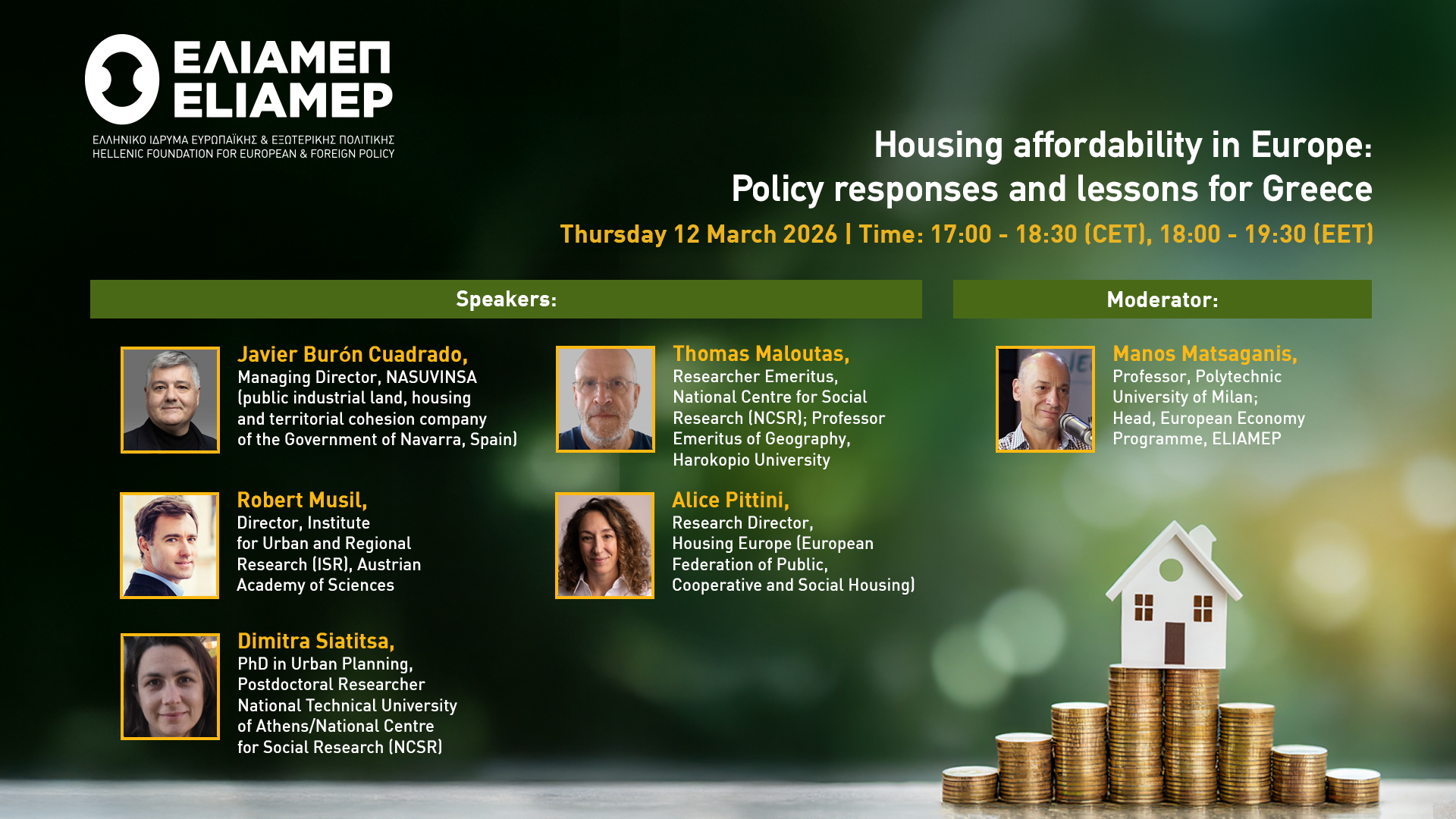
In recent years house prices and rents have risen faster than incomes in several cities in Europe and beyond. This has made access to housing problematic for many households, especially young and low-income ones. Several factors have helped make housing less affordable: global income and wealth inequality; low interest rates and quantitative easing; demographic changes accentuating mismatches between the available housing stock and the types of dwellings people look for; the rise of short-term accommodation platforms; tax policies discriminating in favour of owner-occupied housing; and the deregulation of housing markets and a retreat from public housing. In reaction to all this, governments (national, regional, and local) around Europe, and also the European Union itself, have proposed and implemented a host of policies to make housing more affordable, often targeting young and low-income households. Our roundtable discussion brings together housing experts from around Europe in order to make better sense of recent trends and policy responses, and to tease out what Greece might learn from international experience.
Speakers
Javier Burón Cuadrado, Managing Director, NASUVINSA (public industrial land, housing and territorial cohesion company of the Government of Navarra, Spain)
Thomas Maloutas, Researcher Emeritus, National Centre for Social Research (NCSR); Professor Emeritus of Geography, Harokopio University
Robert Musil, Director, Institute for Urban and Regional Research (ISR), Austrian Academy of Sciences
Alice Pittini, Research Director, Housing Europe (European Federation of Public, Cooperative and Social Housing)
Dimitra Siatitsa, PhD in Urban Planning, Postdoctoral Researcher National Technical University of Athens/National Centre for Social Research (NCSR)
Moderator
Manos Matsaganis, Professor, Polytechnic University of Milan; Head, European Economy Programme, ELIAMEP
The event will be held online in english.
The invitation is available here.
 Projects