Ino Afentouli, Senior Policy Adviser and Head of the Geopolitics and Diplomacy Observatory, ELIAMEP
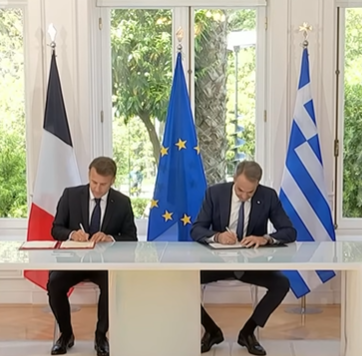
Against a grim international backdrop and the uncertainty exacerbated by the ongoing conflict in the Middle East—with no end in sight—and the conflict in Ukraine, which remains, lest we forget, a European conflict, Macron’s visit to Athens and the renewal of the Greek-French strategic partnership agreement can only be assessed positively.
Nonetheless, now that our long-standing bilateral relationship has been reaffirmed, we need to strengthen it further. The agreement provides for enhanced cooperation in key areas including defence, security, technology and innovation.
For Greece, however, the cornerstone of the strategic partnership is the protective shield France could provide in the event of a threat against Greece from a third country. This provision is reciprocal, but the disparity in power between the two countries makes it less likely that our country will have to come to France’s defence. That said, one should not underestimate the fact that the mutual defence provision adds to the existing obligations arising from the two countries’ membership of both NATO and the EU under, respectively, Article 5 (NATO) and Article 42.7 (TEU). The agreement therefore strengthens the convergence between the two countries within these organisations, and should not therefore be interpreted as a purely bilateral arrangement. This is significant, as both organisations have entered a transformative phase regarding their internal balance of power, given the stated intention of the US to reduce its presence on the European continent.
France in turn is playing a leading role—with Germany—in two processes we believe will proceed in parallel: the creation of a European pillar within NATO, and the gradual construction of a European defence. If these processes unfold smoothly—with a ‘amicable divorce’ from the US leading to a gradual decoupling from its responsibility for European defence—it is realistic to expect that, in the foreseeable future, European countries will be able to defend their territory with their own forces. It is equally realistic to predict that the US will not leave Europe without a nuclear umbrella, as this would heighten the threat from non-European nuclear powers. On this front, too, France recently took the bold initiative of extending its own nuclear deterrent to eight additional European countries, including Greece. The Greek-French agreement is therefore fully aligned with the European framework, making it highly beneficial for our country. To deepen this partnership further, Greece could look to the example of Franco-German cooperation, which, based on the Élysée Treaty (1963), provided the driving force for European integration. Since we
find ourselves at a decisive moment for Europe’s future, participating in enhanced cooperation arrangements will serve to amplify the influence of a small country like Greece.
Sophia Clément Mavroudis, Senior Research Fellow, ELIAMEP
For France, the Franco-Greek Agreement represents both a prototype and a blueprint for the ongoing construction of European defence at a political, industrial and geopolitical level. A new model founded upon concrete cooperation between willing states. This innovation places Greek-French cooperation at the heart of the laboratory for European strategic autonomy, and does so in the geostrategically unstable context of the Eastern Mediterranean.
France is seeking to reclaim European strategic leadership from Germany, reaffirming its self-identification as a ‘framework nation’ in European defence. It serves as a guarantor of European security through its industrial and military clout—a force multiplier that decuples its strategic impact. This agreement also serves as a foundation of the European defence architecture emerging within the framework of NATO’s European pillar, to which it is now clearly complementary. This occurs against the backdrop of growing doubt regarding US support in the event of a conflict in Europe, given Washington’s gradual withdrawal and reassessment of its priorities—namely Asia, the management of multiple theatres, and procurement shortfalls.
Greece is part of the European core and the recipient of reliable security guarantees. It is becoming a leading strategic partner, a steadfast and trusted ally, and a European bulwark in the Eastern Mediterranean capable of playing a key defensive role in the region as a politically stable and militarily capable ally.
The meeting demonstrated that France has made an explicit political and military commitment to support Greece politically, diplomatically and militarily in the event of tensions or outright conflict.
The immediate assistance clause provides for immediate bilateral engagement, a targeted strategic partnership, clear political intent, and a credible deterrent effect. This makes it more robust politically and militarily than both the TEU’s Article 42.7—which is legally strong, but operationally weak—and NATO’s Article 5, which is formidable but politically constrained, lacking military immediacy and being both dependent on the US and inapplicable in disputes between two member nations. It acts as a powerful political deterrent, reducing the political ambiguity which the EU and NATO ‘intentionally’ retain—a factor of particular concern to Greece.
The advanced nuclear deterrence proposed by France to eight countries that have requested it does not constitute an official extension of the French nuclear umbrella; rather, it is a political and strategic tool that lends credibility to the bilateral guarantee. As well as serving as a political demonstration of French deterrence, it ensures that Greek security is incorporated into French strategic calculations. It is of crucial strategic importance to Greece that France has made it clear that any destabilisation of Greece would undermine French strategic interests. This deterrence is both diplomatic and military in nature, involving the deployment of conventional forces within the participating countries (frigates, Rafale fighter jets). Greece is thus transitioning from a traditionally conventional national deterrence strategy to a model of indirect, extended deterrence within the French strategic umbrella.
For France, the industrial cooperation foreseen by the agreement supports the development of a European defence ecosystem with an explicit European preference, and thus represents a significant opportunity for its own national defence industry. For Greece, the agreement consolidates bilateral industrial cooperation and will bolster the Greek defence industrial base—on the proviso that strict oversight is maintained over requirements and procurement. It also supports the co-production, development and strengthening of a future sustainable domestic defence industry that will have an economic, political and social impact.
Finally, for Greece, the agreement represents a strong European political guarantee with a long-term structural rationale. Which is why France would expect Greece to manage, and perhaps in future strike a balance between, its multiple alliances with third countries:
– With the US, the complementarity of defence systems within the framework of NATO’s European core and the priority of Europe’s strategic autonomy.
-With Israel, the management of potential future tensions arising from military decisions, as well as the further integration of air defence systems and the interoperability of weapon systems.
 Experts