


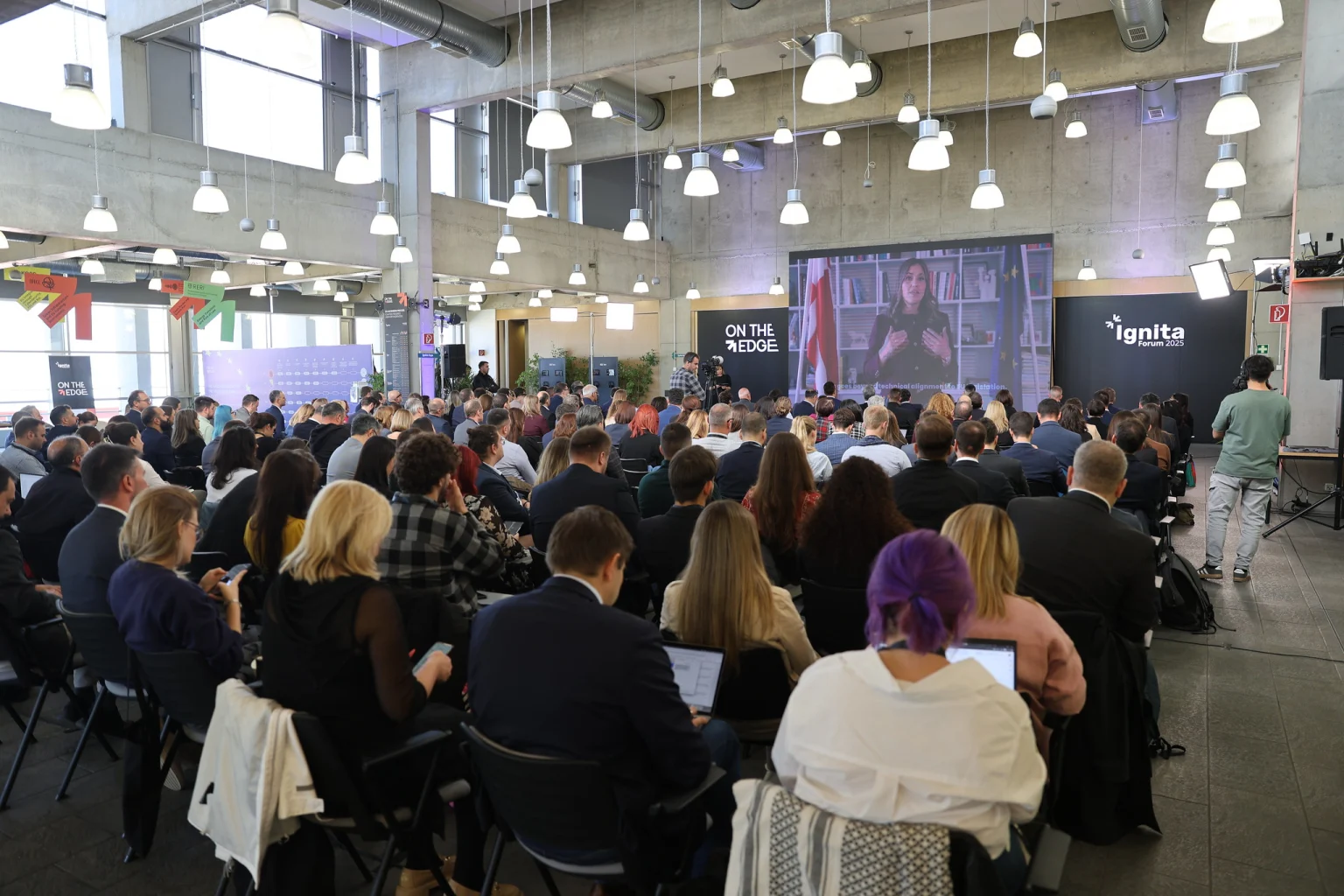

Ioannis Alexandris (Research Fellow, South-East Europe Programme – ELIAMEP; Research Associate, think nea – New Narratives of EU Integration) participated in the IGNITA Forum 2025: “On the Edge”, organised by the Open Society Foundations – Western Balkans and held in Prizren, Kosovo from 8-10 October. The Forum brought together researchers, policymakers, and civil society representatives from the Western Balkans and across Europe to discuss the region’s role in shaping Europe’s future. ELIAMEP is a member of the IGNITA network which is led by led by OSF-WB.
Over the three days, participants addressed themes such as EU enlargement and convergence, the politics of gradual integration, youth engagement and Gen-Z viewpoints, the challenges and the regions potential in green and digital transitions. The Forum also hosted high-level interventions from Prime Minister Albin Kurti, senior EU officials such as the Deputy Head of the EU in Kosovo, Eva Palatova, Montenegro’s chief negotiator with the EU, Predrag Zenovic, as well as leading policy experts from organisations including CEPS, Carnegie Europe, OECD, and the European University Institute.
In his opening remarks, Andi Dobrushi, Director of OSF–WB, stated that “Ignita was built precisely for this moment, a place where civil society can transform waiting into action, fatigue into foresight and fragmentation into convergence”.
Albin Kurti, Prime Minister of Kosovo, mentioned that “Everyone uses the EU as a tool, but having the European Union as a value has been left to the left. Social democrats of our continent should rise to their historical task and embrace this opportunity, in spite of all the risks and dangers that surround us”.
In a video address, Marie Bjerre, Denmark’s Minister for European Affairs, underscored that the fundamental principles of democracy, rule of law and human rights are non-negotiable: “EU membership is not an easy path. Entering the European Union is a long and demanding process. But if we succeed, we will see a much stronger EU in the future, too big an opportunity to miss. And when we do realize a bigger and stronger Union, we might just ask ourselves why it didn’t happen even sooner.”
In his discussions and exchange of views with other participants from leading think tanks and institutions across the region and beyond, including the German Council on Foreign Relations (DGAP), the Italian Institute for International Affairs (IAI) Carnegie Europe, but also several organisations from Albania, North Macedonia, Kosovo, Montenegro and Serbia, Ioannis shared insights on ELIAMEP’s recent and upcoming work under the think nea – New Narratives of EU Integration initiative which is supported by OSF-WB. He drew attention to ELIAMEP’s recent reports on radical right parties and fiscal narratives and the Western Balkans’ potential to contribute to EU defence readiness, as well as the forthcoming research study on critical raw materials, which have already attracted interest among EU stakeholders and will be presented in upcoming high-level discussions in Brussels and key EU capitals.
During the closing session, Lura Limani, Team Lead at OSF–WB, explicitly acknowledged ELIAMEP’s role as a key partner, highlighting its recent contribution and the relevance of its research to current EU policy debates, an endorsement that reflects the growing visibility of ELIAMEP and think nea’s work in regional and European discussions.
Δημοσίευση:
15/10/2025
 Έργα
Αναλυτές
Έργα
Αναλυτές

Ioannis Alexandris
Research Fellow, Wider Europe Programme, Brussels