


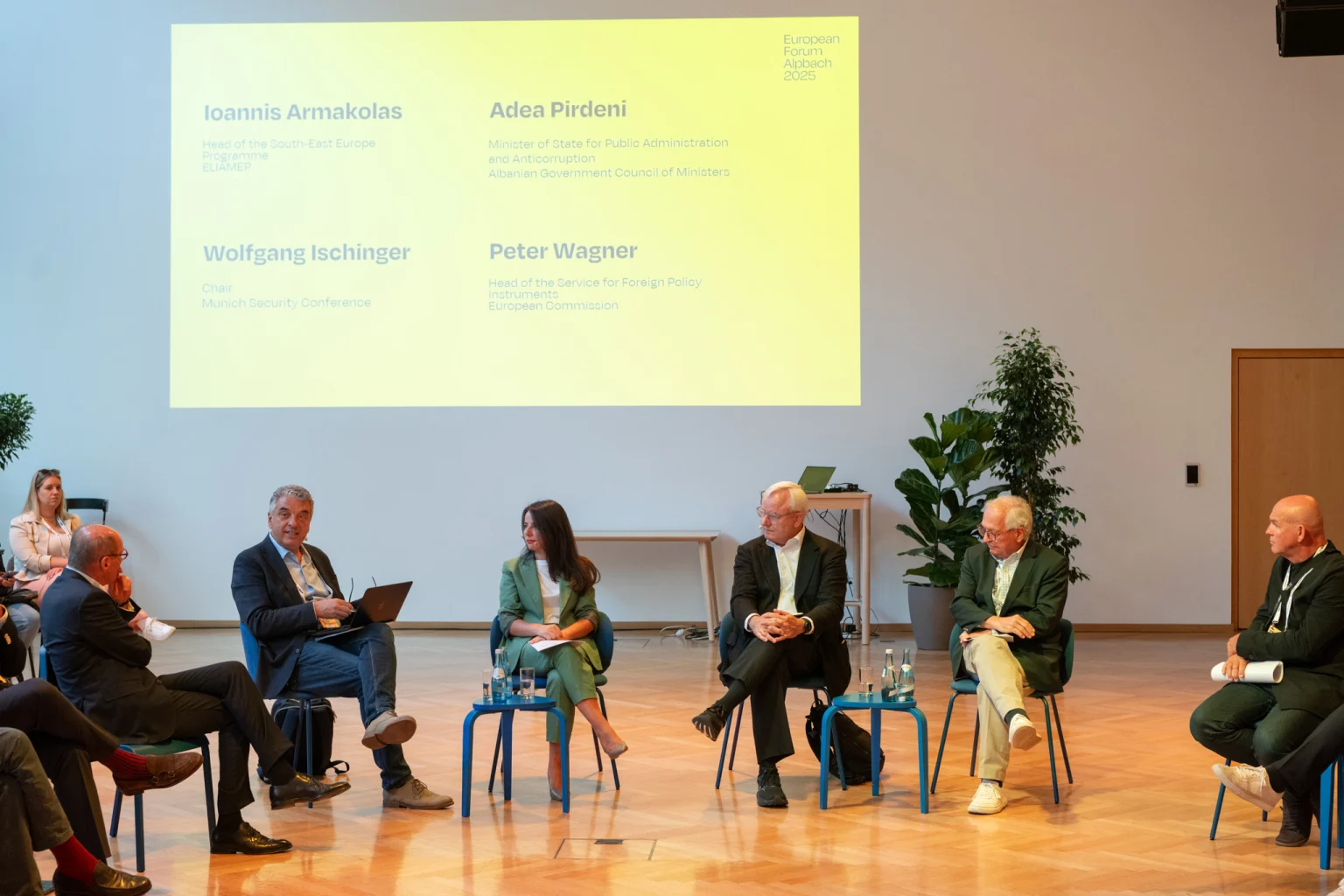

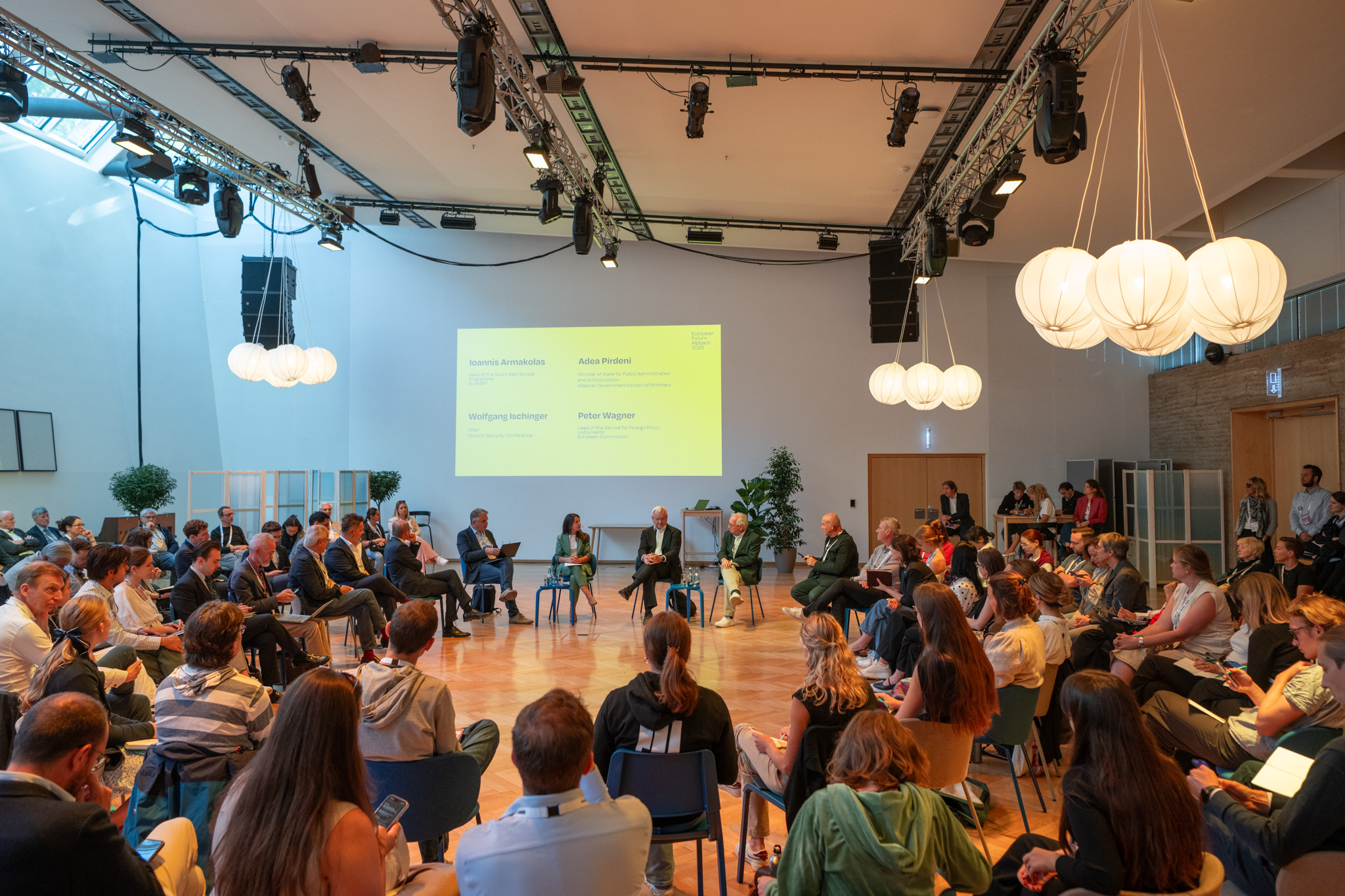
At the European Forum Alpbach, European democracy and its future were at the heart of the discussions, with EU enlargement towards the Western Balkans also firmly on the agenda. The panel entitled “The Centre Must Hold: Geopolitics and the Fragmentation of European Democracy” was held with the support of the Open Society Foundations – Western Balkans. The South-East Europe Programme of ELIAMEP took part in the event in the framework of the initiative think nea – New Narratives of EU Integration, which is likewise supported by the Open Society Foundations – Western Balkans.
The panel was moderated by Ioannis Armakolas, Head of the South-East Europe Programme at ELIAMEP and Director of the initiative. The speakers were:
- Wolfgang Ischinger, President of the Foundation Council, Munich Security Conference Foundation
- Adea Pirdeni, Minister of State for Public Administration and Anticorruption, Albanian Government Council of Ministers
- Peter Wagner, Head of the Service for Foreign Policy Instruments, European Commission
The initiative think nea – New Narratives of EU Integration aims to renew the EU’s commitment to the Western Balkans and strengthen the region’s image within the Union, ensuring a tangible perspective of full membership. In an era of geopolitical upheavals and security challenges, the initiative aspires to become a reference point for keeping the momentum of enlargement alive, not as a technical process, but as a strategic choice for Europe’s own future.
In his opening remarks and in his questions to the speakers, the Director of the initiative, Ioannis Armakolas, presented the main findings of recent reports (on the rise of the far right and enlargement, defence readiness and enlargement, and raw materials and the EU’s strategic autonomy – forthcoming). These insights framed the discussion. He stressed that the far right is increasingly instrumentalizing populist narratives about enlargement across different lines of political confrontation. He further argued that the Western Balkans are becoming ever more relevant to Europe’s strategic autonomy in defence, highlighting that the region can contribute to EU priorities for 2030. Finally, he underlined the importance of raw materials available in the region, which are essential for Europe’s autonomy, and stressed that enlargement must ensure the region is not left in a state of limbo.
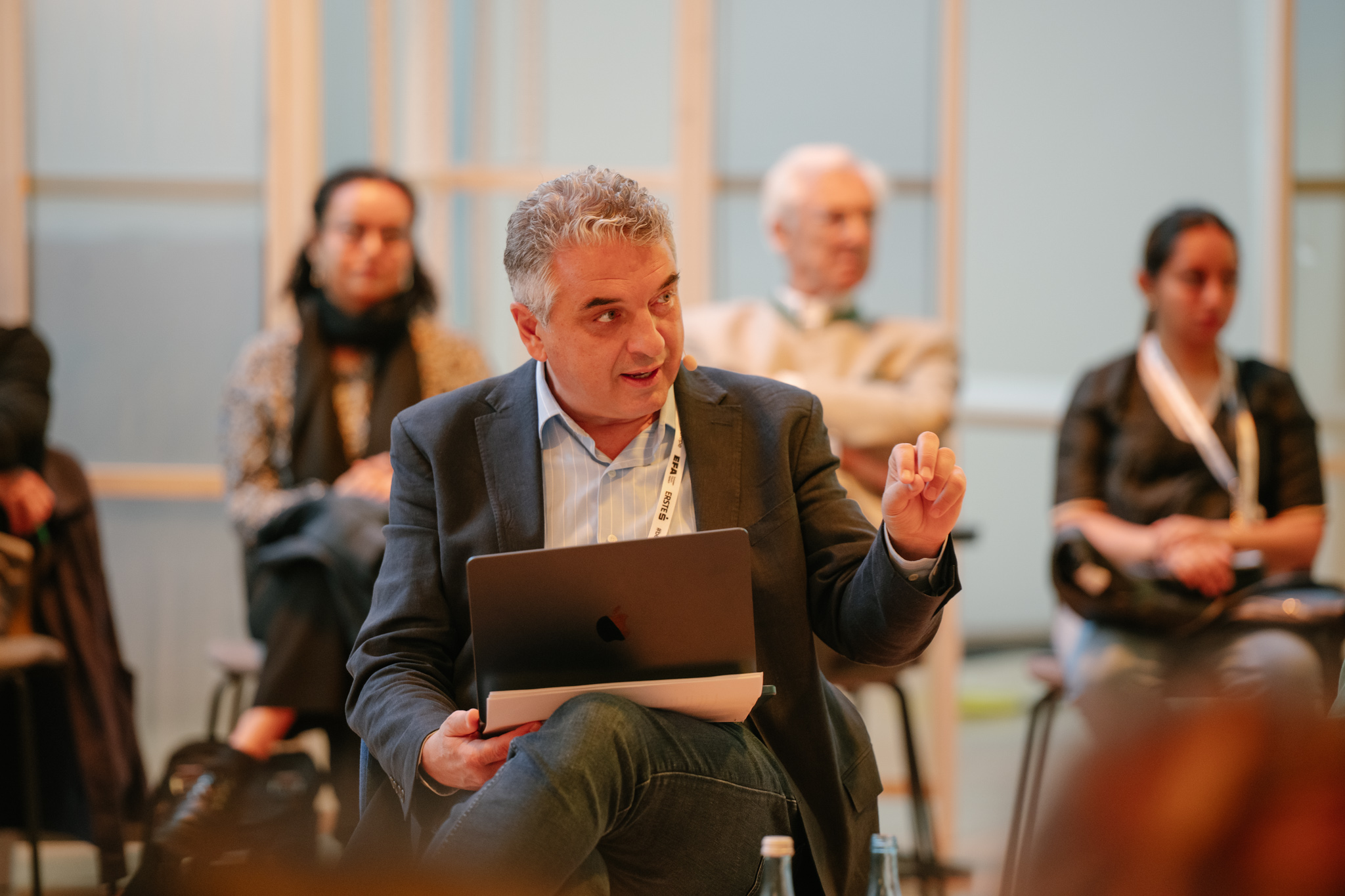
Wolfgang Ischinger was unequivocal on enlargement, noting that while the Copenhagen Criteria were well designed, they no longer reflect today’s urgent realities. He argued that the EU must revise the way it approaches prospective new members.
From the perspective of the Western Balkan countries themselves, Adea Pirdeni emphasized the existential urgency of the 2030 timeframe, warning that a delay in the accession of Albania and Montenegro could place the European project itself at risk. She also stressed that the EU perspective has already pushed countries in the region to overcome deeply rooted problems through reforms and meaningful change.
Peter Wagner highlighted the pace of political change, underlining the importance of involving Western Balkan countries in the sectoral committees where substantive decisions are made.
In closing, Ischinger cautioned that nothing should be taken for granted, not democratic rights, nor even the European Union itself. He stressed the responsibility of all stakeholders to safeguard both democracy and the European perspective of the region.
Δημοσίευση:
28/08/2025
 Έργα
Αναλυτές
Έργα
Αναλυτές

Ioannis Armakolas
Head of the Wider Europe Programme; Senior Research Fellow