


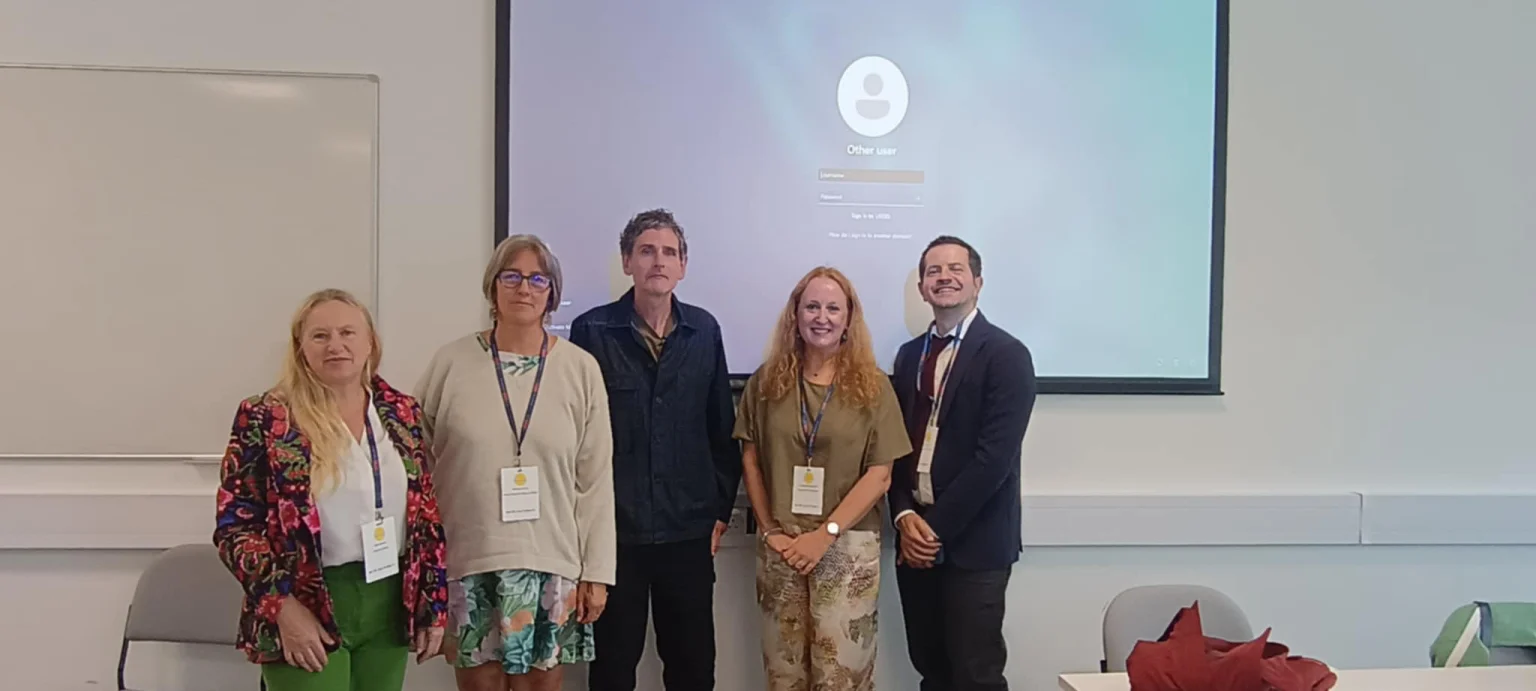

From 31 August to 3 September 2025, the University Association for Contemporary European Studies (UACES) gathered scholars, researchers and practitioners at Liverpool John Moores University to explore Europe’s resilience and transformation in a rapidly changing world. Within this dynamic setting, Fair MusE was prominently represented in the panel “Digitalisation and EU Law: Causes and Effects” (1 September) with Fair MusE’s Evangelia Psychogiopoulou (ELIAMEP & University of the Peloponnese) and Prof. Giuseppe Mazziotti (Fair MusE’s Coordinator and Principal Investigator) acting respectively as panelist and discussant.
The panel brought together four substantial contributions that advanced the debate on how digitalisation is reshaping European governance:
- UK–EU divergence in digital policy. Alison Harcourt and Seamus Simpson (University of Exeter) introduced the co-authored paper “UK and EU Policy Divergence in the Digital Sector”, examining how Brexit has set the EU and the UK on different digital trajectories. They showed how the EU’s digital market policies are increasingly influenced by French- and German-inspired approaches to regulation, emphasising stronger market controls and public interest safeguards, whereas the UK has chosen a path of openness and liberalisation of data flows across borders. They also discussed the EU’s attempt to design a regulatory framework that remains adaptable to technological advancements and market shifts, contrasting it with the UK’s more flexible trade-oriented model. Their comparative analysis highlighted broader questions of regulatory effectiveness and adaptability in an evolving digital landscape.
- Media governance at the crossroads of regulation. Matteo Trevisan (European University Institute) presented a paper, “Intersecting Orbits: The Interplay of the European Media Freedom Act and the Digital Services Act in Shaping Media Governance”, he co-authored with Elda Brogi and Iva Nenadic. In this paper the authors analyse the new European Media Freedom Act and the institutional architecture it introduces — particularly the European Board for Media Services — and examine its interaction with the Digital Services Act. By highlighting the overlapping functions and potential frictions between these legislative frameworks, Trevisan pointed to both the opportunities and challenges of a multi-layered governance model, where the Media Services Board, Digital Services Coordinators and other actors (such as ‘trusted flaggers’) must coordinate to secure effective implementation and enforcement of media and platform regulation.
- AI governance and European values. Fair MusE’s Evangelia Psychogiopoulou turned to the Artificial Intelligence Act. Her paper “EU Values and AI Governance: A European Model in the Making?” explored how the Union’s foundational values, as enshrined in Article 2 TEU, are embedded in the Act’s governance model. She analysed the mechanisms for implementation and enforcement and questioned whether this complex architecture can genuinely uphold the Union’s proclaimed values of democracy, human rights and rule of law in practice, or whether the gap between normative aspiration and regulatory design remains too wide.
- Cybersecurity regulation and institutional complexity. Finally, Federica Casarosa (Sant’Anna School for Advanced Studies) presented “Regulating Cybersecurity: The Role of Independent Authorities”, tracing a decade of EU legislative activity in this area. She mapped the creation of a dense web of European and national authorities tasked with countering cyber threats, showing how their roles and functions have expanded but also how gaps and overlaps persist. Her intervention underscored the challenges of ensuring coherence and effectiveness within a fragmented yet increasingly crucial field of digital governance.
In his discussion Giuseppe Mazziotti reflected on the four contributions through the lens of values and governance. He emphasised the importance of situating debates on digitalisation within broader questions of institutional design, policy coherence and democratic legitimacy. Connecting these issues to the concerns of Fair MusE, he highlighted how online platforms not only transform legal and regulatory frameworks but also deeply influence the economic and ethical value of authors’ rights , the cultural and creative industries, and the music sector in particular.
For Fair MusE, these debates strike at the heart of the project’s research agenda. Fair MusE investigates how digital governance arrangements and algorithmic power shape the way musical compositions, performances and sound recordings are produced, distributed and consumed — and how these dynamics affect the capacity of authors, and performers to be fairly remunerated. By foregrounding values such as transparency, accountability and fairness, Fair MusE seeks to identify pathways towards a more balanced digital ecosystem, in which European policy and regulation can safeguard creativity while respecting music rights-holders’ rights.
To conclude, the session underscored that values and governance arrangements are not peripheral concerns, but central pillars of digital policymaking. As Fair MusE’s work demonstrates, they are indispensable to building a fairer, more sustainable future for music, culture and media at a time when dominant platforms’ algorithms and increasingly pervasive uses of artificial intelligence can easily compress, rather than fostering, media and artistic freedom.
Δημοσίευση:
01/10/2025
 Έργα
Αναλυτές
Έργα
Αναλυτές

Evangelia Psychogiopoulou
Senior Research Fellow, Assistant Professor/University of the Peloponnese, European Law & Governance, Fundamental Rights and EU Values, EU Law-Making, EU Law and Policies for the Digital Transformation, Cultural Diversity, the Media, EU Horizontal Policy Priorities, European Judicial Dialogue