


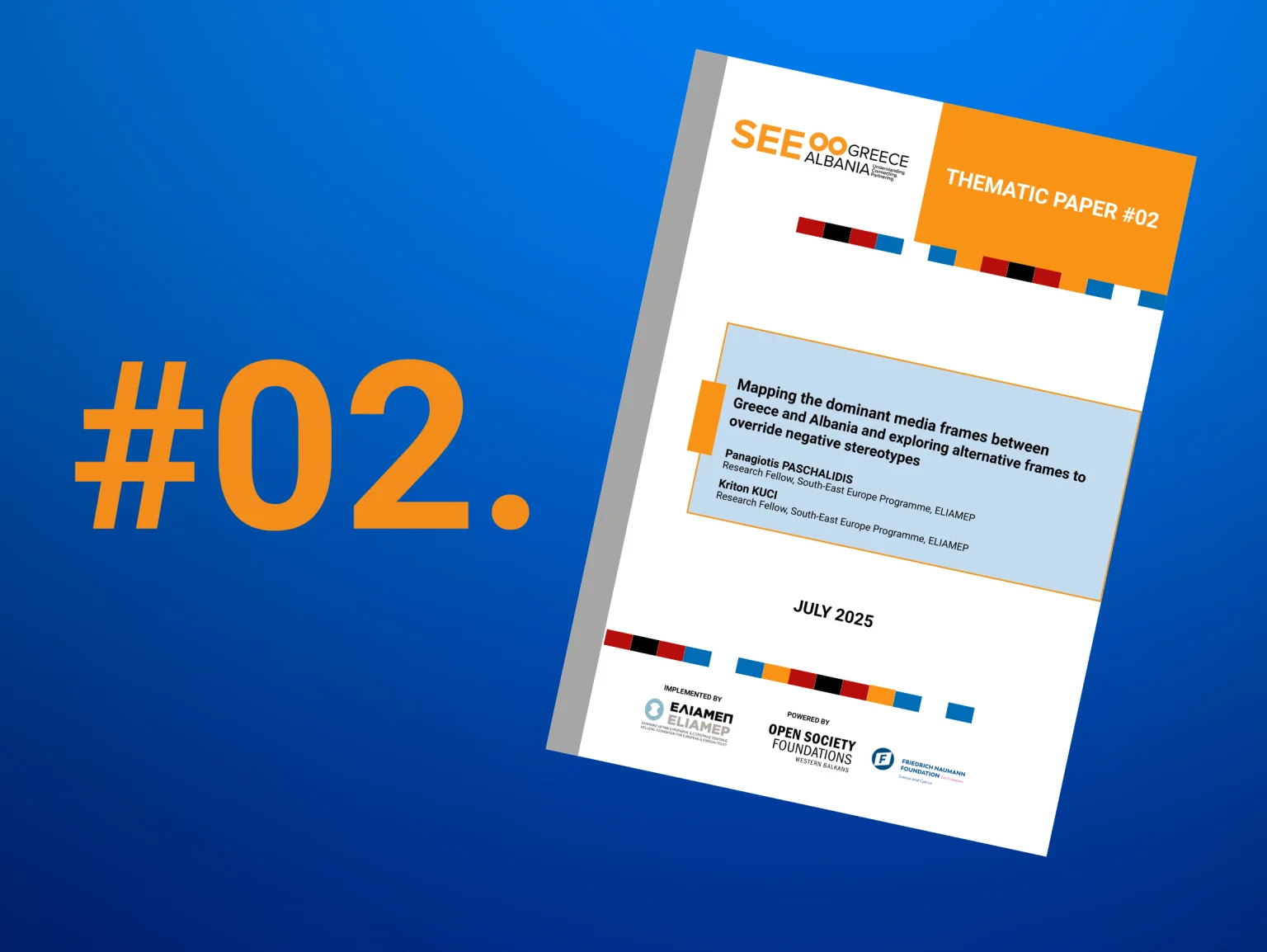

The new ALGREE thematic report entitled “Mapping the dominant media frames between Greece and Albania and exploring alternative frames to override negative stereotypes” is a key output of the “ALGREE – Albania-Greece: Understanding. Connecting. Partnering” project. Authored by Panagiotis Paschalidis and Kriton Kuci, and implemented by the South-East Europe Programme of ELIAMEP, the study investigates the ways in which Greek and Albanian media portray the other’s country and proposes constructive counter-narratives to challenge negative stereotypes.
Using a mixed-method approach that combines quantitative content analysis with qualitative frame analysis, the report explores media coverage through six case studies focused on politically and socially sensitive topics, such as Albania’s EU accession process, the Greek minority in Albania, maritime border disputes, regional dynamics, economic cooperation, and the high-profile “Beleri case.” It examines both the tone and framing of news stories and highlights how political alignment often influences media narratives on both sides.
Its key findings include a persistent politicization of media discourse, a strong focus on conflict-laden narratives, and a lack of attention to positive themes such as culture, society, and economic cooperation. While some progress is noted—particularly regarding regional cooperation and perceptions of economic partnership—the presence of stereotypes remains a significant obstacle to balanced representation.
The report offers a series of recommendations aimed at depoliticizing media narratives and encouraging more nuanced and constructive reporting. By fostering alternative frames that promote mutual understanding, the study contributes to the broader goals of ALGREE in support of evidence-based dialogue, informed policy-making, and improved bilateral relations between Greece and Albania.
You can read the thematic report here.
Categories:
All publications

 Experts

Panagiotis Paschalidis
Research Fellow, Media representations of the Balkan region