


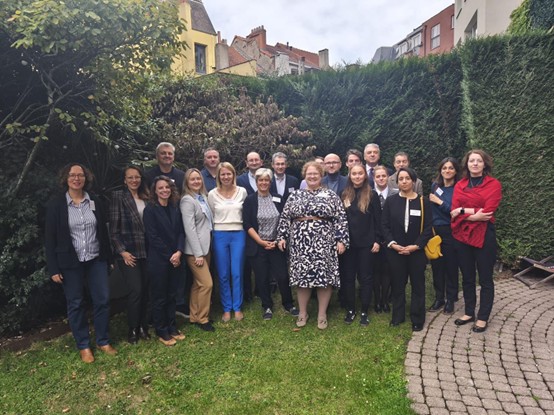

The presentation of the main results of Work Package 7 (WP7) took place in Brussels on 24 September 2025, as part of the final General Assembly meeting of the EMBRACE project. The session brought together consortium partners and experts to reflect on key findings related to the geopolitical dimensions of EU democracy promotion.
Led by Prof. Ioannis Armakolas, Head and Senior Researcher of the South-East Europe Programme-ELIAMEP, the presentation outlined the analytical framework and empirical research developed under WP7 to assess the geopolitical competition faced by the EU in its neighbourhood. Drawing on case studies including Algeria, Georgia, North Macedonia, Serbia and Ukraine, the findings highlighted how domestic political conditions, elite preferences, and governance weaknesses interact with external influences to shape democratic outcomes.
The discussion underscored that EU democracy promotion operates within a contested geopolitical environment, where authoritarian actors such as Russia and China seek to advance their interests, often capitalising on domestic vulnerabilities rather than ideological alignment. The presentation emphasised that the effectiveness of EU democracy promotion depends on consistency, contextual awareness, and credible incentives, including enlargement perspectives and coherent conditionality.
The session also outlined key policy implications and recommendations, including the need for greater strategic coherence, enhanced resilience against foreign interference, and renewed approaches to democracy support that reflect geopolitical realities. Overall, the WP7 presentation provided a comprehensive synthesis of research insights and contributed to broader policy-oriented discussions on how the EU can adapt its democracy promotion strategies in an increasingly complex international environment.
Δημοσίευση:
24/09/2025
 Έργα
Αναλυτές
Έργα
Αναλυτές

Ioannis Armakolas
Head of the Wider Europe Programme; Senior Research Fellow