


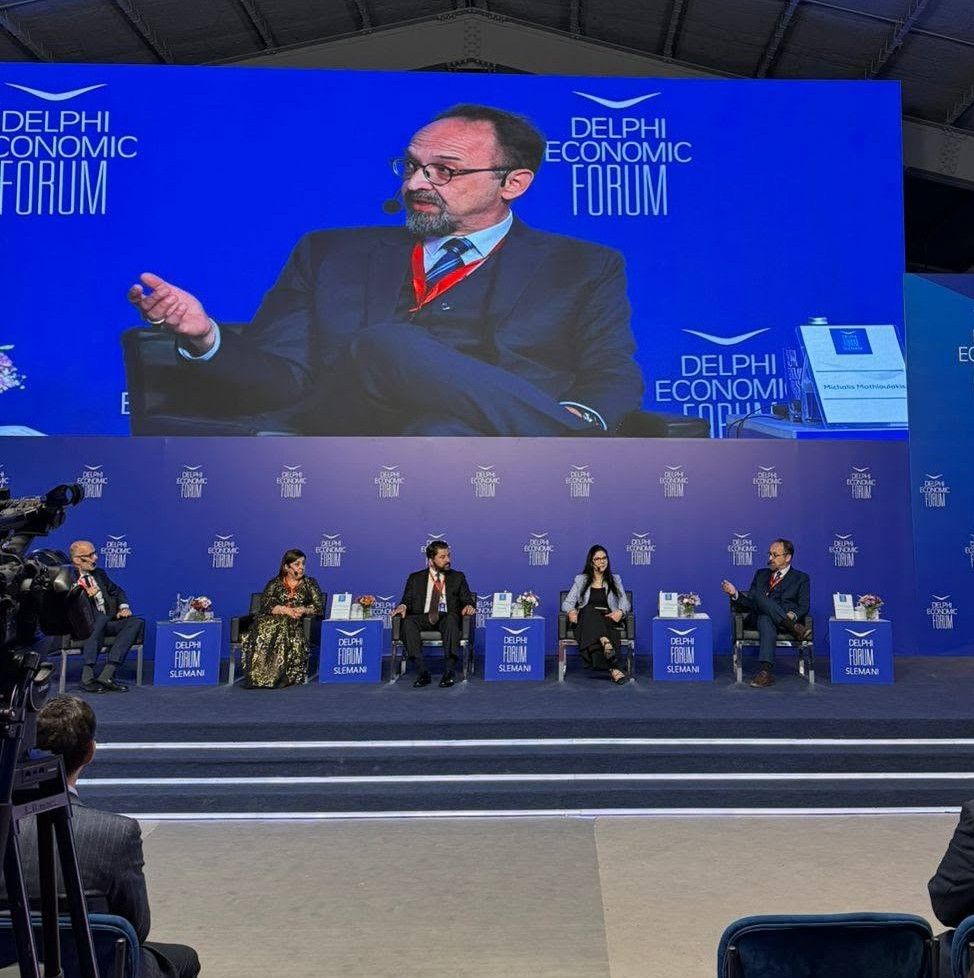
Dr. Michalis Mathioulakis participated in the Delphi Forum Slemani, held in Sulaymaniyah, in the Kurdistan Region of Iraq, following an invitation by the Delphi Economic Forum, which organized the initiative for the second consecutive year and held under the auspices of the Greek Ministry of Foreign Affairs and Enterprise Greece.
The Forum brought together political leaders, policymakers, academics, and analysts from the Middle East and Europe to discuss major geopolitical, economic, and strategic challenges facing Iraq, the Kurdistan Region, and the wider Middle East and North Africa (MENA) region. Discussions focused on regional security, energy security and the energy transition, economic diversification, investment opportunities, and the evolving geopolitical landscape.
Dr. Mathioulakis participated in the Energy panel alongside H.E. Begard Talabani, Minister of Agriculture and Water Resources of the Kurdistan Region, H.E. Ahmad Mufti, Deputy Minister of Natural Resources of the Kurdistan Region, and Ms. Ana Birchall, former Deputy Prime Minister, and Minister of Justice of Romania. The discussion focused on the energy transition and its geopolitical implications.
During his intervention, Dr. Mathioulakis argued that energy transition strategies are often approached primarily through technical and economic considerations, while their geopolitical dimensions remain insufficiently addressed. He stressed that energy transition projects can only be considered truly strategic when they strengthen a state’s position within the international system by enhancing its capacity to project influence or reduce external vulnerabilities.
He further highlighted that one of the principal obstacles to large-scale energy transition efforts in hydrocarbon-exporting countries is the potential loss of geopolitical power associated with fossil fuel resources, combined with the difficulties of achieving regional cooperation for the development of cross-border clean energy networks. He also emphasized that energy-related national power derives not only from the control of energy production but equally from the control of energy networks and infrastructure.
According to Dr. Mathioulakis, the long-term success of the energy transition in the Middle East will depend on the ability of regional actors to transform power based on energy resources into power based on diversified and interconnected energy networks.
On the sidelines of the Forum, Dr. Mathioulakis underlined the importance of maintaining close engagement between Greece, Iraq, and the Kurdistan Region, noting that initiatives such as the Delphi Forum Slemani contribute to strengthening valuable channels of dialogue and cooperation. From an energy perspective, he stressed that the post-crisis landscape in the Middle East is expected to shape new energy corridors and patterns of energy flows, developments that will have significant implications for Greece and make active engagement in the region a strategic necessity.
Watch the discussion here.
 Αναλυτές
