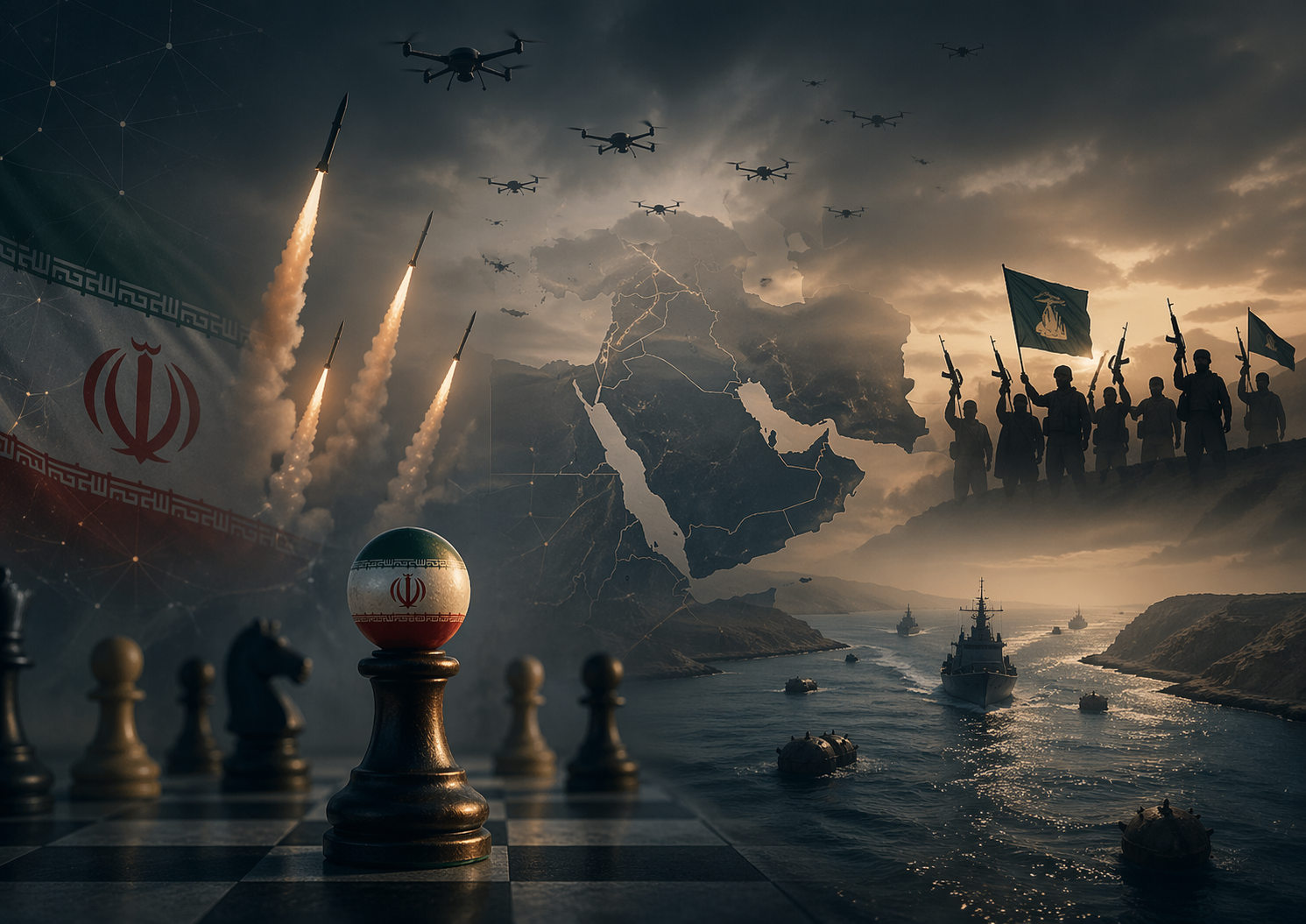
In the third policy paper of the collection The Iran reckoning: Essays on a war the West was not ready for, Dr. Andréas C. Hatzidiakos argues that Iran developed a four-pillar asymmetric doctrine to make military confrontation structurally intolerable for Western powers by imposing high human, financial and political costs. However, this strategy failed – in making it intolerable – against a rule-breaking American leadership, which risks ultimately accelerating regional nuclear proliferation and creating a more dangerous strategic landscape.
Executive Summary
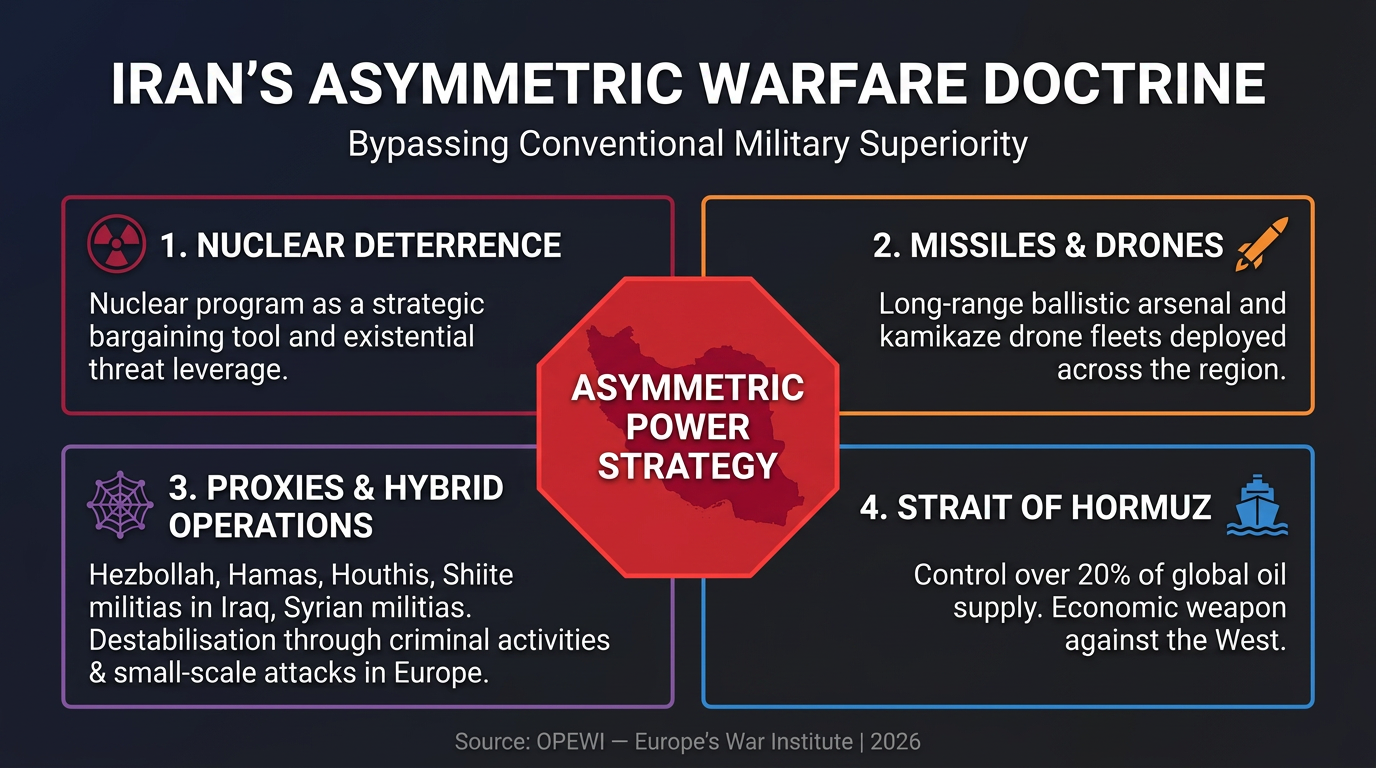
This policy paper evaluates Iran’s “layered deterrence” architecture, a four-pillar strategy developed over forty years to make the cost of military confrontation structurally intolerable for Western powers. Made more pressing by the conventional collapse of Iraq in 2003, Tehran shifted toward making victory prohibitively expensive through human, financial, and political cost-imposition, as evidenced by Operation Epic Fury. The doctrine leverages high-volume, low-cost drone and missile swarms to neutralise expensive Western precision munitions, nuclear ambiguity for deterrence, an ideological proxy network capable of multi-front operations without direct Iranian attribution, and the geographic weaponisation of the Strait of Hormuz to hold 20% of global oil supplies hostage. While strategic nuclear ambiguity aimed to deter “rule-following” adversaries, the 2026 war demonstrates that such proximity can instead become a casus belli for “rule-breakers”, likely accelerating future nuclear proliferation across the region.
The doctrine of structural intolerability. Following the 2003 fall of Baghdad, the Islamic Revolutionary Guard Corps (IRGC) concluded that conventional parity with the United States was impossible. In response, Tehran engineered a comprehensive asymmetric deterrent designed to target an adversary’s political will rather than battlefield outcomes. This system was sustained through five decades of “war economy” conditions, where sanctions failed to constrain defense procurement, instead fostering domestic manufacturing and opaque procurement networks that are structurally invisible to standard Western compliance instruments.
Pillar I: Kinetic asymmetry. Iran has transformed its ballistic arsenal from a liquid-fueled, inaccurate force into a precision-guided, solid-fueled inventory capable of striking targets up to 4,000 km away, placing European capitals within theoretical range. The defining feature of this pillar is the “devastating arithmetic” of drone warfare. By fielding $20,000 Shahed-136 drones against $3 million Patriot interceptor missiles, Iran forces adversaries to deplete high-value, finite munition stocks against high-volume, cheap platforms. Iran does not seek to contest air superiority directly but to make its maintenance prohibitively expensive.
Pillar II: The Nuclear Paradox. For two decades, Iran utilised weapon-grade nuclear proximity as “strategic insurance”, remaining close enough to the threshold to deter, yet ambiguous enough to avoid a casus belli. The 2026 war exposed a fatal flaw in this logic: ambiguity only deters adversaries constrained by international rules. By failing to provide a definitive deterrent, Iran’s proximity to a weapon became the very justification for pre-emption. Consequently, even if nuclear negotiations resume, Tehran will likely conclude that only confirmed weaponisation prevents external strikes. More worryingly, other regional actors might draw the same conclusions.
Pillar III: Proxy architecture and hybrid operations. Tehran’s regional reach is sustained through an ideologically constituted network of non-state actors – including Hezbollah, the Popular Mobilization Units, and the Houthis – that extends Iranian military power across five countries without deploying uniformed Iranian personnel. Unlike transactional alliances, these relationships are rooted in doctrinal loyalty to the Supreme Leader, allowing Iran to disperse adversary resources across multiple fronts simultaneously.
Pillar IV: Weaponisation of geography. The Strait of Hormuz remains Iran’s most powerful bargaining chip. By utilising – or threatening to do so – naval mines, fast-attack boats, and coastal batteries, Iran can transform the Persian Gulf into an operationally prohibitive hazard zone. Iran does not need to successfully close the Strait militarily; the mere threat of mining triggers the withdrawal of maritime insurance and the suspension of carrier services, effectively self-closing the chokepoint and inducing global economic shocks.
Concluding remarks. The Iranian doctrine did not fail due to internal incoherence; it failed because it assumed a rational, “rule-following” adversary in Washington, that wouldn’t launch a pre-emptive strike. However, in asymmetric terms, the Iranian regime achieves victory simply by surviving the world’s most powerful military. For European planners, the primary risk is a “proliferation cascade” among regional neighbours and a permanent shift in military capabilities needs at a moment where Europeans have already started rearming.
Policy recommendations. Europe (not necessarily the EU) must act on several fronts simultaneously: rebalancing defence procurement toward scalable, low-cost systems; developing a coherent post-2026 non-proliferation strategy with credible regional security guarantees; operationalising a joint counter-hybrid framework to disrupt Iran’s criminal-proxy networks; and accelerating strategic energy diversification. A foundational imperative is to rebuild collective security architecture through purpose-built “minilateral” coalitions, grounded in shared vulnerability rather than institutional consensus, and ensuring that Europe is present, not merely affected, wherever its strategic interests are decided.
Read here in pdf the Policy paper by Dr Andréas C. Hatzidiakos, Research Fellow, ELIAMEP; Co-director of OPEWI (Europe’s War Institute).
WHEN OPERATION EPIC FURY WAS LAUNCHED on 28 February 2026, the Houthis held their fire for four weeks – an initial restraint that proved, in retrospect, to be deliberate strategic patience. Their 28 March missile salvo against Israel signalled that the period of restraint had ended and that Iran’s proxy architecture remained fully operational and under coordinated command, waiting to be activated.
This is the operational expression of a doctrine built over four decades at the highest levels of the Islamic Revolutionary Guard Corps. A doctrine designed to answer a single strategic question: how does a state unable to match American conventional power make the cost of confrontation intolerable? Iran’s answer is one of the most comprehensive asymmetric deterrence architectures in modern strategic history. The West spent twenty years declining to take it seriously. The price of that complacency is now being paid in full.
The lessons of 2003 and the birth of a doctrine
On 9 April 2003, American forces entered Baghdad. The Iraqi army – once assessed as the fourth largest in the world – had been dismantled in twenty-one days. Iranian strategic planners, watching from Tehran, drew their conclusions rapidly and without ambiguity: a state that meets the United States in conventional battle loses. Not eventually. Immediately. The lesson was not theoretical; it was operational, and it was absorbed at the highest echelons of the Islamic Revolutionary Guard Corps (IRGC) with a clarity that shaped the entirety of Iran’s subsequent defence investment and strategy.
…by imposing costs in human, financial, political, and reputational capital that exceed what a democratic society is willing to sustain. At every escalatory level, Iran engineered a cost-imposition mechanism targeting political will rather than battlefield outcomes.
Tehran’s conclusion was analytical, not defeatist: a state unable to match American conventional military power must instead construct a system that makes confrontation structurally intolerable – not by making victory impossible, but by imposing costs in human, financial, political, and reputational capital that exceed what a democratic society is willing to sustain. At every escalatory level, Iran engineered a cost-imposition mechanism targeting political will rather than battlefield outcomes. This is the foundational logic of asymmetric deterrence – and Iran pursued it with an institutional coherence the West consistently underestimated. Kim Jong-il drew the same conclusion from 2003 and acted on it: North Korea’s first nuclear test in October 2006 established a deterrent that has held – no external power has struck Pyongyang since. Iran registered this lesson but chose a more complex architecture: not a single deterrent, but a layered system designed to impose costs simultaneously at every escalatory level.
Iran’s asymmetric doctrine was forged under economic siege. Operating under comprehensive US sanctions since 1995, UN Security Council measures since 2006, and the reimposition of maximum-pressure sanctions following Washington’s 2018 Joint Comprehensive Plan of Action (JCPOA) withdrawal, the regime absorbed successive waves of external compression. Their cumulative effect decimated household savings collapsed the currency and progressively hollowed out the middle class – precisely the constituency most likely to generate pressure for political moderation.
Western governments assumed that economic pressure would produce political compliance. The empirical record suggests the opposite. Sanctions functioned as a structural shock that concentrated economic power within state-controlled networks and eliminated the social constituency most capable of sustaining organised opposition – consolidating authoritarian control rather than undermining it. What sanctions conspicuously failed to constrain was Iran’s defence procurement. Five decades of operating under economic siege produced an institutional culture in which sanctions circumvention was not an emergency measure. It was standard operating procedure.
The youngest cohort of Iranian military and defence planners – those now in their thirties and forties within the IRGC – have never known an open economy. For this generation, war economy conditions are not an exception: they are the baseline. The institutional ingenuity required to sustain a sophisticated weapons programme against the most extensive sanctions regime in modern history has not weakened Iranian defence capability. It has strengthened it, by forcing the development of domestic manufacturing capacity, reverse-engineering competence, and procurement networks structurally invisible to standard compliance instruments.
Iran has constructed one of the most adaptive sanctions-evasion architectures in the world.
Iran has constructed one of the most adaptive sanctions-evasion architectures in the world. Its core instruments are well-documented: a shadow fleet of a few hundred tankers operating under opaque ownership structures and without standard insurance[1], under flags of convenience and using deceptive practices (AIS signal manipulation, ship-to-ship transfers), generating oil revenues that are laundered through transaction layering, falsified documentation, and offshore shell companies before being directed toward defence procurement[2]. The components required for Iran’s UAV and missile programmes are procured through parallel front-company networks: an April 2023 OFAC (Office of Foreign Assets Control) designation exposed one such network operating simultaneously across Iran, Malaysia, Hong Kong, and the People’s Republic of China, specifically tasked with electronic component procurement for UAV production[3]; a December 2023 designation identified a further network supplying IRGC aerospace units with servomotors subsequently recovered from Shahed-136 fragments in Ukraine[4].
The comprehensive doctrine that emerged rests on four distinct but mutually reinforcing pillars, each designed to compensate for a specific conventional deficit. It was not assembled incrementally or accidentally. It was ratified by Khamenei as a top-down strategic directive following 2003, formalised within IRGC planning structures, and funded – despite severe sanctions pressure – as an absolute institutional priority for over two decades.
The first pillar – offensive deterrence: missiles and drones
The first and most visible pillar of Iran’s asymmetric deterrent is kinetic: a ballistic missile and drone programme of a scale that Western assessments consistently underestimated and continued to underestimate well into the course of the 2026 conflict. Prior to the 2025 “12-day war”, US Central Command estimated Iran’s total ballistic and cruise missile inventory at over 3,000 systems[5] – the largest such arsenal in the Middle East – built over two decades of sustained investment despite comprehensive international sanctions.
Pre-war estimates of Iran’s total missile inventory ranged from 1,700 to 6,000 units[6], already reflecting deep uncertainty about concealed stockpiles. Post-February 2026, estimates of the remaining stockpile diverge most sharply, reflecting the fog of active conflict. US intelligence sources assessed that roughly half of Iran’s launchers remain operational and thousands of short and medium-range ballistic missiles remain stockpiled[7]. Other sources indicate that the remaining operational stock is estimated at 445-1,700 missiles[8]. The variance reflects a structural intelligence problem: Iran’s underground “missile cities” in the Zagros Mountains make physical inventory assessment extremely difficult.
Iran proved it has a capability that places London, Paris, and Berlin within theoretical strike range.
The programme spans short-range Fateh and Shahad-2 variants (300-500 km range) through to medium-range missiles including the Emad (1,700 km) and Ghadr-1 (1,950 km), capable of striking Israel, US bases across the Gulf, and critical infrastructure throughout the Arabian Peninsula[9]. More significantly, the March 2026 launch of two ballistic missiles toward Diego Garcia – at approximately 3,800 km from Tehran – revealed a two-stage system with an estimated range of 4,000 km not previously attributed to Iran’s declared arsenal. The strategic significance of this attack is independent of its outcome: Iran proved it has a capability that places London, Paris, and Berlin within theoretical strike range.
Two decades of focused investment have transformed the qualitative character of this arsenal.
Two decades of focused investment have transformed the qualitative character of this arsenal. The shift from liquid-fuelled to solid-fuelled propulsion has dramatically reduced launch preparation time, making pre-emptive targeting by adversaries exponentially more difficult[10]. Circular error probable – the statistical radius within which half of fired missiles land – has improved from hundreds of metres in the Shahab series to 10-30 metres in newer systems such as the Fateh-313 and Zolfaghar variants.
The drone dimension represents the most consequential adaptation of all. Iran’s Shahed-136 one-way attack drone – a design indirectly inspired from reverse-engineering a captured American RQ-170 Sentinel in 2011[11] and subsequently developed indigenously – costs approximately $20,000-35,000 per unit. A single American MQ-9 Reaper costs $30 million. One Patriot interceptor missile costs $3-4 million. The arithmetic is devastating in its implications: Iran can field a salvo of 1000 drones for the same cost as approximately seven US interceptors, each of which can destroy only one drone. The asymmetry forces adversaries to deplete high-value, difficult-to-replace munition stocks against high-volume, cheap, and easily replaced platforms.
The costs of the opening days of Operation Epic Fury have already illustrated this dynamic precisely. American operational expenditure was estimated at approximately $1.9 billion per day, with $11.3 billion spent by Day 6 and $16.5 billion by Day 12[12] – in significant part on intercepting Iranian drone and missile salvoes, and on the replacement cost of precision munitions expended at an unprecedented rate[13].
The strategic logic found its clearest illustration on 27 March 2026, when an Iranian barrage of ballistic missiles and attack drones struck Prince Sultan Air Base in Saudi Arabia, destroying a Boeing E-3G Sentry AWACS and damaging multiple KC-135 tankers essential to sustaining air operations over Iran[14]. Iran did not attempt to contest US air superiority directly; it targeted the command-and-control architecture upon which that superiority depends – not defeating American airpower, but making it prohibitively costly to maintain.
The US has acknowledged this asymmetric logic by doing something remarkable: reverse-engineering the Iranian design.
The US has acknowledged this asymmetric logic by doing something remarkable: reverse-engineering the Iranian design. SpektreWorks, an Arizona-based firm, produced the LUCAS FLM 136 (Low-Cost Unmanned Combat Attack System)[15], a direct copy of the Shahed-136 at comparable unit cost – an extraordinary admission that the most militarily significant drone in current use is an Iranian design[16] (itself partly inspired from a captured American UAV – the circle is complete). Iran industrialised asymmetric air warfare before any Western defence establishment fully processed what that meant. The bill for that institutional failure is being paid in real time.
Two conflicts, fought on different terrain and by different logics, have delivered the same verdict: mass, cost-efficiency, and distributed lethality outperform exquisite capability.
Europeans’ risks compounding that failure: as rearmament budgets surge across the continent, the predominant impulse seems to favour conventional high-end platforms over the mass-producible, low-cost/low-tech systems that both Ukraine and Iran have demonstrated to be operationally decisive. European defence procurement – already exposed by Ukraine as structurally ill-suited to the tempo of high-intensity conflict, optimised as it was for Cold War deterrence geometries rather than contested, multi-domain environments[17] – now faces renewed confirmation in the current Iran conflict. Two conflicts, fought on different terrain and by different logics, have delivered the same verdict: mass, cost-efficiency, and distributed lethality outperform exquisite capability. The lesson of this war – that a $20,000 drone can neutralise a $3 million interceptor – has been written in fire; the question is whether European defence planners are finally reading it.
The second pillar – nuclear ambiguity as strategic insurance
The ambiguity Iran had cultivated as a shield became, in Washington’s calculus, a casus belli in itself.
The second pillar of Iran’s deterrence architecture operates not in the kinetic, but the existential register. For two decades, Tehran calibrated its nuclear programme to remain permanently proximate to weapons capability without formally crossing the threshold. Close enough to deter, ambiguous enough to deny any adversary a clear casus belli. The 2026 war exposed a fatal paradox at the heart of this strategy: it was not the crossing of the nuclear threshold that triggered pre-emption, but the sustained proximity to it. The ambiguity Iran had cultivated as a shield became, in Washington’s calculus, a casus belli in itself.
As of late 2024, Iran’s nuclear programme had advanced to a point at which it possessed sufficient enriched material for five to six weapons if further processed to weapons-grade level within approximately two weeks[18], and enough for nine weapons within one month[19]. Its stockpile included 408.6 kg of uranium enriched to 60% purity – a single technical step from weapons-grade – representing a 49% increase since February 2025[20]. Israeli strikes in the June 2025 “12-Day War” degraded industrial-scale enrichment capacity at Natanz and Fordow significantly, but critically failed to eliminate this stockpile, with the IAEA subsequently losing oversight of those materials[21].
In a rules-based international order […] strategic ambiguity would have been sufficient.
The strategic value of nuclear ambiguity is not difficult to understand: it constrains adversary decision-making without requiring the full political and international cost of declared weaponisation. In a rules-based international order where the credible threat of collective security mechanisms constrained unilateral military action, strategic ambiguity would have been sufficient. But that assumption presupposes an adversary willing to be constrained by those rules. Operation Epic Fury demonstrated it did not.
…ambiguity deters rule-followers, not rule-breakers.
By remaining below the threshold of confirmed weaponisation, Iran removed the one deterrent that would have rendered this operation politically and strategically unthinkable – and learned the lesson it will not forget: ambiguity deters rule-followers, not rule-breakers. This war may thus be the event that finally persuades Tehran to pursue nuclear deterrence in earnest[22] – a logic the North Korean precedent had already established definitively: Pyongyang has not been struck since 2006. The paradox of this war is clear: nuclear risk is not reduced – it is accelerated. The IAEA (International Atomic Energy Agency) has explicitly acknowledged that it has “lost continuity of knowledge” over Iran’s centrifuge inventory and enriched material[23]. Short of complete regime elimination, Iran will exit the conflict with its nuclear knowledge and likely key materials intact[24]. In other words, war has made future negotiations far more difficult.
President Macron’s announcement of a “forward deterrence” framework […] will prove insufficient if Europe simultaneously fails to adapt.
More troubling still, the states most likely to draw Tehran’s lesson – that only confirmed nuclear capability deters rule-breakers – are in Europe’s immediate neighbourhood: Saudi Arabia, Turkey, Egypt, and potentially Indo-Pacific actors. A resulting proliferation cascade is not a peripheral consequence of a distant war; it is a direct and central threat to European security architecture. President Macron’s announcement of a “forward deterrence” framework[25] with eight European partners in March 2026 is a direct institutional response to the lessons of this war. But a doctrine calibrated for nuclear escalation management will prove insufficient if Europe simultaneously fails to adapt to adversaries who have specifically studied how to make high-end Western capabilities prohibitively expensive to operate.
The third pillar – proxy architecture and hybrid operations
…the construction of a regional network of armed non-state actors […] was a rational strategic calculation.
The third pillar of Iran’s strategy represents its most sophisticated long-term investment: the construction of a regional network of armed non-state actors that extends Iran’s military reach across five countries without requiring the deployment of a single uniformed Iranian soldier. This network was not ideologically improvised. It was a rational strategic calculation, accelerated after 2003, built on a prototype established with Lebanese Hezbollah in 1982. Nor was it sectarian: Iran demonstrated consistent strategic pragmatism by financing and arming Hamas – a Sunni Islamist movement – with rockets, military training, and an estimated $70-100 million annually at the relationship’s peak, securing a permanent armed presence on Israel’s southern border. Theology was subordinated to geometry.
This architecture forces adversaries onto multiple simultaneous fronts, dispersing resources, enabling cost-imposition without attribution, and keeping escalatory control in Tehran’s hands.
The architecture is extensive. Hezbollah functions as a state-within-a-state in Lebanon, with its own military command structure operating entirely outside Lebanese Army authority – and whose strategic direction ultimately answers to Tehran’s Supreme Leader[26]. The Popular Mobilisation Units (PMU) are formally embedded within the Iraqi Armed Forces and report directly to the Iraqi Prime Minister – yet in practice, their leadership openly answers to the Iranian Supreme Leader[27]. Comprising approximately 67 predominantly Shia factions, the PMU constitutes a permanent branch of Iranian-led forces within Iraq’s security apparatus, which represents arguably the most structurally significant penetration of a sovereign state’s official military apparatus in the contemporary world.
The Houthi movement controls over 2000 km of Yemen’s Red Sea coastline[28] – the western approach to the Bab al-Mandab Strait, through which approximately 12% of global trade transits annually – demonstrating that Iran’s deterrence architecture extends to the physical chokepoints of the global economy[29]. Syrian networks provide depth, logistics hubs, and forward basing. Iran finances this network through a combination of state budget transfers and, critically, illicit financial flows through hawala networks, front companies, and informal transfer systems that function entirely outside the international banking architecture[30].
This architecture forces adversaries onto multiple simultaneous fronts, dispersing resources, enabling cost-imposition without attribution, and keeping escalatory control in Tehran’s hands. The Houthi missile launched toward Israel on 28 March 2026 – as US-Israeli strikes continued against Iranian territory – was a precisely timed signal: the proxy network remains operational and its reach undiminished. What makes this architecture exceptional is not its geographic span but the nature of its loyalty: these are not transactional alliances but ideologically constituted relationships built across four decades, rooted in Khomeini’s founding doctrine that the Islamic Republic could only survive by exporting itself[31]. Hezbollah’s 1985 “Open Letter”[32] pledges allegiance not to Lebanon but to the Supreme Leader – a doctrinal commitment never retracted. When Hezbollah launched rockets into Israel within hours of Khamenei’s assassination – at enormous cost to the Lebanese people – it was acting on theology, not tactics, subordinating its own interests to Iran’s.
Iran’s asymmetric doctrine extends into the adversary’s home territory through calibrated hybrid campaigns.
Iran’s asymmetric doctrine extends into the adversary’s home territory through calibrated hybrid campaigns or even operations. MI5 has disrupted over forty Iran-backed potentially lethal plots in the UK between January 2022 and October 2025[33], while Europol formally assessed on 5 March 2026 that the Iran conflict carries “immediate repercussions for serious and organised crime and terrorism in the EU”[34]. Iran’s systematic use of European criminal networks to conduct operations while severing visible links to Tehran has extensively been documented[35]. Notably, this network has not yet been activated for large-scale hybrid operations – a restraint that may reflect deliberate strategic reservation, or equally, the operational decapitation of the command layer that would have directed it.
The fourth pillar – weaponisation of geography
Geography is the fourth weapon. The Strait of Hormuz narrows to 33-39 km at its narrowest point, with navigable shipping lanes of 3 km in each direction. The Persian Gulf beyond is not merely a wider version of the same corridor: it is an enclosed maritime theatre of approximately 251,000 km², accessible through a single entrance, and physically dominated by Iranian coastal positions for the entirety of its northern shore. Iran’s doctrine combines naval mines, anti-ship ballistic missiles, fast-attack swarm boats, and coastal land-based systems into an integrated layered architecture designed not to defeat a US carrier strike group in open battle, but to make entry into (and exit from) the Persian Gulf operationally prohibitive.
Iran has been developing and rehearsing maritime denial operations in this space for decades.
Iran has been developing and rehearsing maritime denial operations in this space for decades. This operational heritage dates at least to the 1980-1988 Iran-Iraq War, during which Iran conducted systematic minelaying campaigns in the Persian Gulf, most notably triggering Operation Earnest Will[36] and the parallel covert Operation Prime Chance[37]. The seizure of the Iran Ajr – an amphibious landing ship used by Iran to lay naval mines during the Iran-Iraq War – and the recovery of its logbook provided irrefutable evidence of a deliberate, state-directed denial strategy – one designed to impose disproportionate costs on adversaries with minimal conventional force. That the United States had witnessed this playbook firsthand decades prior, makes the absence of a credible counter-strategy a distinctly American policy failure.
The strategic and economic stakes are without parallel. Approximately 20% of global petroleum consumption and one-fifth of global LNG trade transit Hormuz annually[38]. When Iran closed the Strait of Hormuz on March 4, 2026, Brent crude surged over 40%[39], war-risk insurance premiums spiked and major insurers suspended Gulf coverage due to safety concerns, while the IMF revised its 2026 global growth forecast down to 3.1%[40] – warning that a prolonged closure could bring the world close to recession. The theoretical became operational, with cascading effects dwarfing anything the COVID-era supply chain disruptions had produced.
Iran’s mine stockpile – estimated at between 3,000 and 5,000 naval mines – represents the ultimate geographic weapon. It does not need to be deployed in its entirety. A limited seeding of the chokepoint, conducted by fast boats within hours of a political decision to escalate, transforms the Persian Gulf from a global energy corridor into a hazard zone. Iran does not even need to deploy a single mine: as March 2026 demonstrated, the threat of mining the Strait is sufficient – insurers withdraw, carriers suspend services, and the chokepoint closes itself.
As publicly evidenced during this war, there is no readily available alternative route for the majority of Gulf producers: the existing pipeline bypass capacity – the Saudi East-West pipeline and the Abu Dhabi Fujairah link – account for only a fraction of pre-war Hormuz throughput. Hormuz is not merely a chokepoint in the geographical sense. It is the centrepiece of a maritime denial strategy built, refined, and held permanently in reserve as the terminal card in Iran’s escalatory deck.
The threat calculus sharpens when Hormuz is read alongside Bab al-Mandab.
The threat calculus sharpens when Hormuz is read alongside Bab al-Mandab. A dual closure – Hormuz sealed by Iranian assets, the Red Sea interdicted by Houthi forces – would simultaneously sever Gulf energy exports and the food supply of states importing over 80% of their needs by sea[41]. Egypt would face a compounding blow: a Red Sea disruption threatens not only its trade flows but its sovereign revenue base – the Suez Canal, nationalised in 1956, cannot function as a bypass if the corridor feeding into it is closed. As of April 2026, this scenario is declared, not theoretical: Major General Abdollahi has explicitly threatened to halt all trade across the Persian Gulf, Sea of Oman, and Red Sea. In a single move, Iran would activate both its geographic weapon and its proxy architecture (as a final resort?) – the combinatorial logic its deterrence design was always built around.
The relevant actor here may this time be Europe broadly conceived […] rather than the EU as an institution.
Europe is not without assets in this theatre. EUNAVFOR ASPIDES, launched in February 2024 and extended through 2026, has demonstrated the EU’s capacity to project defensive naval force in contested maritime corridors[42]. Proposals to extend its mandate to the Strait of Hormuz have been tabled, but the unanimity requirement of EU decision-making renders rapid reorientation structurally difficult[43]. The Franco-British-led “Strait of Hormuz maritime navigation initiative” convened in Paris on 17 April 2026 – bringing together some thirty-nine nations, including non-EU partners – offers a more agile instrument, better suited to the operational timeline this crisis demands[44] and acknowledges the need for a more global collaboration. Yet neither mechanism addresses the deeper asymmetry: Europeans bear strategic exposure without commensurate voice at the Washington-Tehran negotiating table – a structural deficit that the Macron-Starmer initiative of April 2026 begins to address, echoing in its bilateralist logic, if not in its context, the Saint-Malo declaration of 1998 that launched what is now the Common Security and Defence Policy (CSDP). The relevant actor here may this time be Europe broadly conceived, led by two nuclear powers and permanent members of the UN Security Council, rather than the EU as an institution. The parallel with Ukraine is instructive: as in 2022, Europeans find themselves materially exposed to a conflict they did not initiate, institutionally constrained in their response, and diplomatically sidelined from the negotiations that will determine its outcome. The lesson from both crises is the same – European strategic autonomy is not a long-term ambition to be deferred; it is an operational necessity whose absence carries an immediate and quantifiable cost.
Final insights
Against any adversary operating within the constraints of the rules-based international order – bound by UN Charter prohibitions on preventive war, accountable to its own constituency as well as allied opinion, and exposed to the institutional friction of collective security mechanisms – Iran’s strategy would have been sufficient. The architecture was sound. The logic was coherent. The miscalculation was not strategic but diagnostic: Iran correctly read the international system, but incorrectly read the man controlling the most powerful military within it. President Trump expended an extraordinary volume of American political capital, financial resources, and institutional credibility – accumulated over eight decades of post-war US foreign policy – on an operation whose strategic gains will be, when this war will end, at best contested and, at worst, transient.
Iran built the most sophisticated asymmetric deterrence architecture in the modern era, and was undone (not defeated), not by superior strategy, but by the absence of the strategic and military rationality its entire doctrine had assumed.
The cost-imposition logic Iran spent four decades constructing in order to avoid pre-emptive war did not fail because it was wrong. It failed because it was designed for a rule-follower, and encountered a rule-breaker. The central irony of Operation Epic Fury is precisely this: Iran built the most sophisticated asymmetric deterrence architecture in the modern era, calibrated to the rational behaviour of liberal democracies – and was undone (not defeated), not by superior strategy, but by the absence of the strategic and military rationality its entire doctrine had assumed.
In the strategic grammar of asymmetric conflict, survival against the world’s most powerful military constitutes victory.
There is a deeper paradox at the heart of this war that no tactical success can dissolve: the Iranian regime won by not losing[45]. In the strategic grammar of asymmetric conflict, survival against the world’s most powerful military constitutes victory, and resilience against overwhelming firepower, constitutes humiliation of the attacker. The US, conversely, lost by not winning immediately, decisively and irreversibly. Whatever the final military outcome, the strategic landscape is worse than February 2026: a potentially radicalised successor regime, a shattered but vindicated doctrine, and a nuclear programme whose knowledge base is irreversible.
The Islamic Republic was founded on theology […] what remains is a kleptocratic apparatus sustained not by ideology but by shared liability.
The Islamic Republic was founded on theology; it is sustained by coercion. The generation willing to die for Khomeini’s doctrine is gone – what remains is a kleptocratic apparatus whose population has long understood that the revolution was not exported, but privatised. What remains of the regime’s coercive capacity is thus sustained not by ideology but by shared liability – its enforcers fighting not for God but for their own survival. A state that cannot convert its own population into a strategic asset must permanently divert resources to policing it, and that is a structural drain no missile stockpile can compensate. Yet the only outcome that forecloses reconstitution is the complete elimination of the Islamic Republic as a governing entity – because any remnant will rebuild, faster, with greater urgency, and with one lesson burned into its institutional memory: that it should have pursued nuclear weaponisation far sooner, and far more resolutely, than it did.
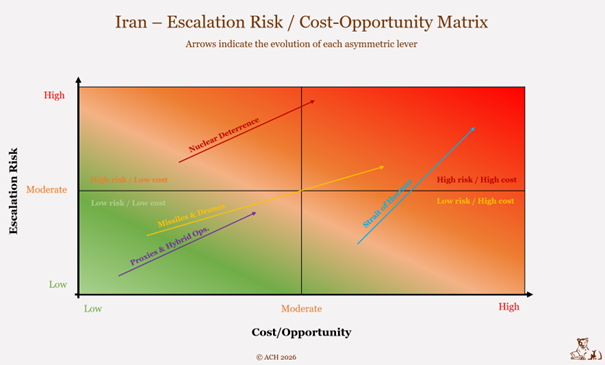
Each arrow runs from a starting point (latent state, low intensity) to an endpoint (maximum activation):
- ☢️ Nuclear deterrence – a lever with very high escalation risk but moderate cost, since the threat alone is sufficient to produce its effect
- 🚀 Missiles & drones – usable at low cost or deployed as a massive strike
- 🕸️ Proxies & hybrid ops – a lever with low direct escalation risk and low cost, the most frequently activated on a day-to-day basis
- 🚢 Strait of Hormuz – a lever with enormous global economic cost and very high escalation risk, as any closure would be considered a casus belli
| Lever | Latent State | Maximum Activation |
| ☢️ Nuclear | Program under development, strategic ambiguity | Declared weaponisation |
| 🚀 Missiles & drones | Tests, capability demonstrations | Massive regional strikes |
| 🕸️ Proxies & hybrid ops. | Financing, training | Coordinated attacks in Europe |
| 🚢 Hormuz | Verbal threats, naval manoeuvres | Effective closure of the strait |
[1] UK National Crime Agency, “Networks and Shadow Fleets”, 11/2025.
[2] US Department of the Treasury (USDT), Financial Crimes Enforcement Network (FinCEN), “Advisory on the Iranian Regime’s Illicit Oil Smuggling Activities, Shadow Banking Networks, and Weapon Procurement Efforts”, 06/06/2025. See also DLA Piper, “US Treasury Doubles Down on Fighting Iranian Illicit Finance and Supply Chain Networks”, 11/06/2025.
[3] USDT, Office of Foreign Assets Control (OFAC), “Treasury Sanctions Procurement Network Supporting Iran’s UAV and Military Programs”, Press release, 19/04/2023. See also USDT, OFAC, “Treasury Sanctions Transnational Procurement Network Supporting Iran’s One-Way Attack UAV Program”, Press Release, 27/09/2023.
[4] USDT, OFAC, “Treasury Targets Procurement Network Across Middle East and East Asia Supporting Iran’s UAV Program”, Press release, 19/12/2023.
[5] Commander General Kenneth McKenzie testified in 2022 that Iran had an inventory of “over 3000 ballistic missiles of various types”. See Department of War (DoW) Transcripts, Senate Armed Services Committee Hearing on the Posture of United States Central Command and United States Africa Command, 15/03/2022. See also Congressional Research Service, “U.S. Military Operations Against Iran’s Missile and Nuclear Programs”, page 1, 06/03/2026. The IISS Military Balance 2025 (February 2025) placed the MRBM inventory at approximately 3200 units across Shahab-3, Ghadr-110, and Emad variants.
[6] Chloé Hoorman, Elise Vincent, Soaring ammunition cost turns Iran conflict into “war of stockpiles”, Le Monde, 21/03/2026, citing independent military sources that put the pre-war range at 1700-2900.
[7] Michael R. Gordon, “Iran Has Thousands of Missiles and Could Retrieve Launchers, U.S. Intelligence Finds”, The Wall Street Journal, 10/04/2026.
[8] Hoorman and Vincent, op. cit.
[9] For a list of Iran’s ballistic and cruise missiles: Missile Threat.
[10] Liquid-fuelled missiles (Shahab) require up to an hour of preparation on a fixed pad. Solid-fuelled systems (Fateh-313, Zolfaghar) launch from mobile vehicles in under ten minutes, making them less visible and vulnerable.
[11] On 05/12/2011, Iranian forces captured an American RQ-170 Sentinel UAV near Kashmar, reverse-engineered it to develop the Shahed 171 Simorgh and Saeqeh variants. This capture accelerated Iran’s entire UAV program by providing aerodynamic and systems knowledge. The Shahed-136’s delta-wing loitering munition design is a distinct development line. David Sanger, Eric Schmitt, “Drone Crash in Iran Reveals Secret U.S. Surveillance Bid”, The New York Times, 07/12/2011.
[12] Mark Cancian, “Iran War Cost Estimate Update: $11.3 Billion at Day 6, $16.5 Billion at Day 12”, Center for Strategic and International Studies, 13/03/2026.
[13] Congressional Research Service, “U.S. Military Operations Against Iran’s Missile and Nuclear Programs”, page 1, 06/03/2026.
[14] NBC News, “Vital U.S. Radar Aircraft Was Destroyed by Iranian Strike on U.S. Base in Saudi Arabia”, 30/03/2026.
[16] Paul Iddon, “By Reverse-Engineering Shahed Drone, U.S. Gives Iran a Dose of Its Own Medicine”, Forbes, 07/12/2025.
[17] Josep Borrell, Former High Representative of the European Union for Foreign Affairs and Security Policy / Vice-President of the European Commission, “Lessons from the War in Ukraine for the Future of EU Defence”, European External Action Service, 29/05/2023.
[18] Arms Control Association, “The Status of Iran’s Nuclear Program”, 02/2024.
[19] Institute for Science and International Security, “Analysis of IAEA Iran Verification and Monitoring Report – August 2024”, 09/09/2024.
[20] International Atomic Energy Agency (IAEA), “Verification and Monitoring in the Islamic Republic of Iran in light of United Nations Security Council resolution 2231”, 31/05/2025, p. 9. See also Institute for Science and International Security, “Analysis of IAEA Iran Verification and Monitoring Report – May 2025”, 09/06/2025.
[21] Rafael Grossi (IAEA DG), “Statement to the UN Security Council on the Situation in Iran”, 20/06/2025.
[22] Georgia Cole, “The Iran War Risks Triggering a New Wave of Nuclear Proliferation”, Chatham House, 30/03/2026.
[23] IAEA, “Verification and Monitoring in the Islamic Republic of Iran in light of United Nations Security Council resolution 2231”, 31/05/2025, p. 3.
[24] Arms Control Association, “U.S. War with Iran: New and Lingering Nuclear Risks”, Issue Briefs Vol. 18, Issue 4, 10/03/2026.
[25] Emmanuel Macron, “Statement by the President of the French Republic on the Nuclear Deterrent”, 02/03/2026.
[26] Council on Foreign Relations, “What Is Hezbollah?”, CFR Backgrounders, updated 02/03/2026.
[27] Johanna Moore, Annika Ganzeveld, “The Leadership and Purpose of Iraq’s Popular Mobilization Forces”, Institute for the Study of War, 19/03/2024.
[28] European Parliament Research Service, “Maritime Security: Situation in the Red Sea and EU Response”, 01/2024.
[29] International Crisis Group, “Calming the Red Sea’s Turbulent Waters”, Middle East Report N°248, 21/03/2025.
[30] USDT, FinCEN, “Iranian Shadow Banking: Trends in Bank Secrecy Act Data”, Financial Trend Analysis, 23/10/2025.
[31] Guido Steinberg, “The ‘Axis of Resistance’: Iran’s Expansion in the Middle East Is Hitting a Wall”, Stiftung Wissenschaft und Politik (SWP), German Institute for International and Security Affairs, Research Paper 6, 08/2021.
[33] Sir Ken McCallum (Director General, MI5), Annual Threat Update, 08/10/2024 and Annual Threat Update, 16/10/2025.
[34] Jan Op Gen Oorth (Europol Head of Communications), reported in: “Europol Warns of Elevated Terrorism Threat in EU amid Iran Conflict”, Euronews, 06/03/2026.
[35] Matthew Levitt, Olivia Cardone, “Iranian External Operations in Europe: The Criminal Connection”, ICCT, 16/10/2024; Julian Lanchès, “Hybrid Threat Signals: Assessing Possible Iranian Involvement in Recent Attacks in Europe”, ICCT, 23/03/2026.
[36] The largest U.S. naval convoy operation since World War II.
[37] Through this operation, U.S. special operations forces intercepted Iranian minelayers laying ordnance in international shipping lanes in September 1987.
[38] US Energy Information Administration, “Amid Regional Conflict, the Strait of Hormuz Remains Critical Oil Chokepoint”, Today in Energy, 16/06/2025.
[39] Ad Hoc News, “Brent Crude Surges Over 40% in March 2026 as Geopolitical Tensions Escalate”, 31/03/2026
[40] International Monetary Fund, “World Economic Outlook”, 14/04/2026.
[41] Joseph Glauber, “Iran War: Potential Food Security Impacts”, IFRI, 06/03/2026.
[42] Council of the EU, (CFSP) 2026/778, on a European Union maritime security operation to safeguard freedom of navigation in relation to the Red Sea crisis (EUNAVFOR ASPIDES), 31/03/2026.
[43] Euronews, “EU weighs extending naval mission Aspides to Strait of Hormuz”, 14/03/2026.
[44] Elysée, Strait of Hormuz maritime navigation initiative, 17/04/2026.
[45] Paraphrasing Kissinger quote about the Vietnam war: “The guerilla wins if he does not lose”.
 Experts