


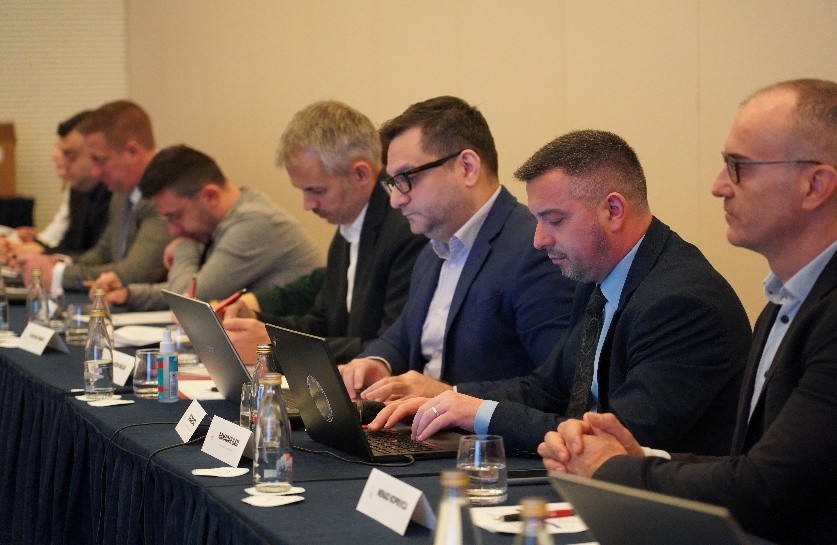

Bledar Feta, Research Fellow at ELIAMEP and member of the GEMS project, participated in the Western Balkans Regional Workshop: Building Democratic Resilience to Foreign Authoritarian Influence, organised by the International Republican Institute (IRI) in Btudva, Montenegro, on 28-29 January 2026. The event brought together policymakers, civil society representatives, and researchers from across the Western Balkans to develop concrete policy responses to foreign authoritarian influence in the region.
During the workshop, Feta presented key findings from his empirical research on China’s influence in Albania, drawing on his report published by the Center for European Policy Analysis (CEPA). As he notes in the study, “China’s tactics for advancing influence permeate all levels of society in Albania. From major Chinese investments in Albanian strategic sectors such as energy to cultural investments in state-owned radio stations and Confucius Institutes.”
According to Feta, China’s strategy in Albania operates through four main channels:
- Expanding exports and investments to increase Albania’s economic dependence on China.
- Leveraging state-linked actors to cultivate political influence.
- Promoting a favourable image of China within Albanian society.
- Strengthening China’s media presence and visibility in the public sphere.
Feta argues that this multi-layered approach has already made China Albania’s significant trading partner, increased public interest in Chinese culture and history, and expanded China-related media coverage. At the same time, he highlights that Albania’s strong pro-Western orientation continues to act as a buffer, limiting Beijing’s political penetration compared to other countries in the region, such as Serbia and North Macedonia.
In his intervention, Feta also emphasised the growing exploitation of online environments by malicious actors seeking to shape narratives and mobilise supporters. Drawing on insights from the GEMS project, he explained how empirical research in gaming communities revealed a concerning overlap between geopolitical discussions and gaming-related conversations. This dynamic creates opportunities for malign actors, posing as ordinary gamers, to insert political narratives, influence younger audiences, and normalise disinformation.
These findings underscore the need to prioritise cybersecurity and the online information space in efforts to strengthen democratic resilience. As Feta stressed, safeguarding digital environments is now essential to protecting democratic societies from foreign authoritarian interference.

Δημοσίευση:
10/02/2026
 Έργα
Αναλυτές
Έργα
Αναλυτές

Bledar Feta
Research Fellow, Foreign policy, domestic politics, human rights in South-East Europe