


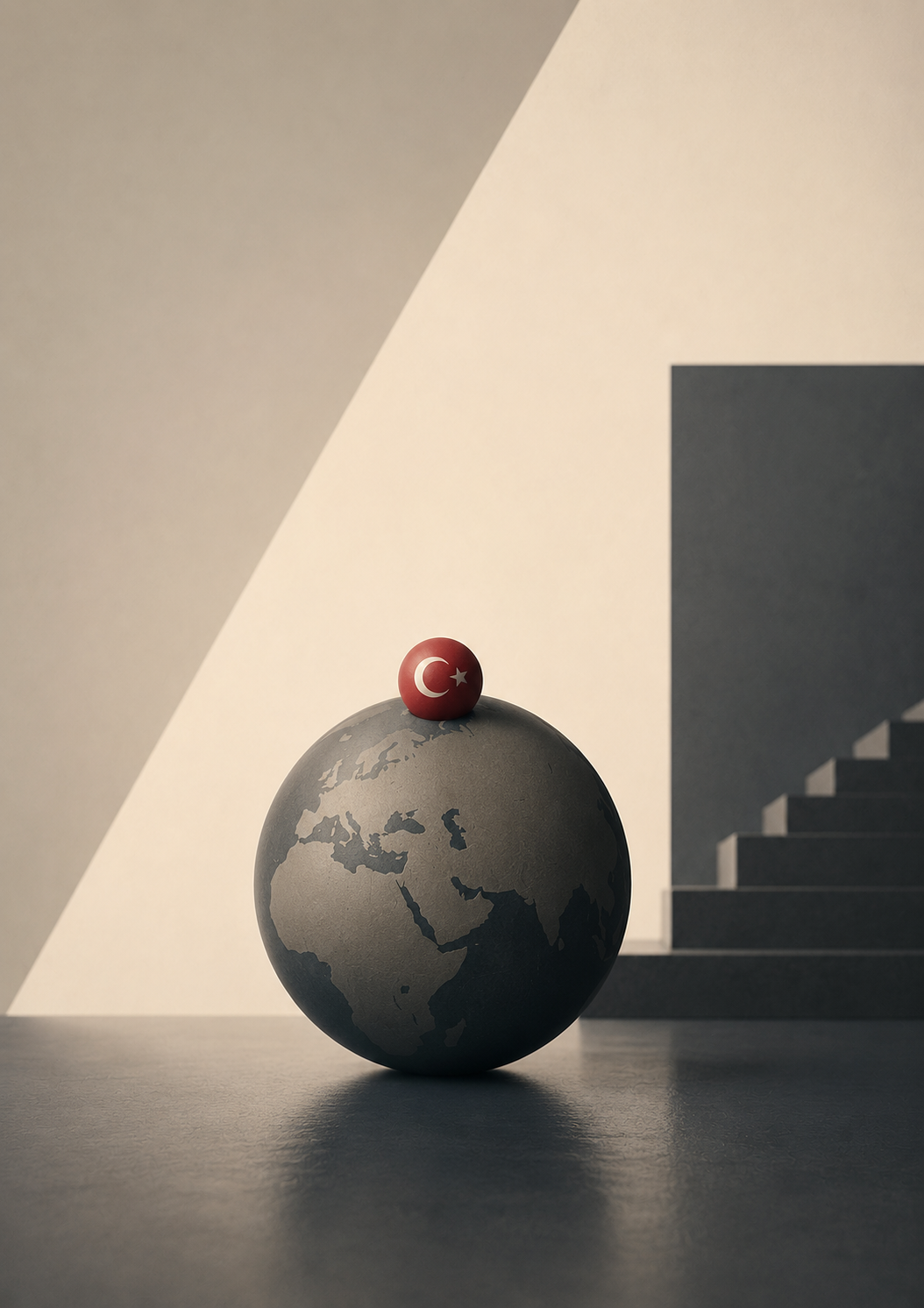
- Turkey’s middle-power status is neither rhetorical inflation nor a recent discovery; it is the product of a long-standing strategic self-positioning that combines NATO-embedded military weight, geostrategic exposure, diplomatic activism, defence-industrial growth, and regional reach. Ankara’s middle-power identity is therefore not merely about prestige, but about converting vulnerability into influence and exposure into diplomatic relevance.
- The core of Turkey’s middle-power behaviour lies in “calibrated non-exclusivity”: Ankara remains anchored in NATO, European markets, and Euro-Atlantic institutions, while simultaneously expanding room for manoeuvre with Russia, the Gulf, Central Asia, Africa, and parts of Asia. This does not amount to a full break with the West, but to a strategy of staying connected everywhere while becoming fully dependent nowhere.
- Turkey’s defence-industrial rise, especially through drones, unmanned systems, and new European partnerships such as Baykar–Leonardo and Hürjet-related cooperation with Spain, has transformed hard power into diplomatic leverage. Turkish military capacity is no longer only about deterrence; it now creates export ties, training networks, maintenance dependencies, and political influence across conflict zones and partner states.
- Geography is both Turkey’s greatest constraint and its greatest asset. The Russia–Ukraine war, Syria, Iraq, Iran–Israel tensions, the Eastern Mediterranean, and the South Caucasus all expose Turkey to overlapping crises; yet the same geography allows Ankara to act as a connector between Europe and the Middle East, NATO and the Black Sea, energy producers and consumers, and conflict zones and negotiation tables.
- Turkey’s biggest problem is not the absence of middle-power resources, but the difficulty of converting them into durable credibility. Economic fragility, inflation, currency volatility, democratic backsliding, weak rule-of-law perceptions, politicised institutions, and the unresolved post-Erdoğan question all limit Turkey’s ability to become a more trusted, coherent, and institutionally continuous middle power.
Read here in pdf the Working paper by Ahmet Erdi Öztürk, Non-Resident Senior Scholar, Turkey Programme, ELIAMEP.
Mark Carney, Canada’s prime minister and former governor of both the Bank of Canada and the Bank of England, has recently helped reopen the wider debate on middle powers by arguing that, in a fractured international order, “middle powers must act together, because if you are not at the table, you are on the menu.” Yet for Turkey, this conceptual framework is far from a novelty; rather, it represents a long-standing element of its diplomatic self-definition. Ankara has been presenting itself in broadly middle-power terms for decades: as early as 1998, Foreign Minister İsmail Cem argued that Turkey aspired to a “pivotal role” in Eurasia rather than a peripheral one. More recent Turkish foreign-policy doctrine has continued to situate the country in an expansive strategic space stretching across the Balkans, the Middle East and North Africa, the South Caucasus, and Central Asia. In this sense, Turkey did not discover the middle-power idiom after the current crisis of world order; rather, it was utilizing this framework to articulate its foreign-policy identity well before leaders such as Carney returned the concept to the forefront of geopolitical debate. This self-positioning is also grounded in material capability. NATO has repeatedly described Turkey as the ally with the second-largest army in the Alliance—a military weight that matters in a volatile neighbourhood where regional instability it is not a peripheral concern for Turkish strategy is not external to Turkish strategy but intrinsic to its immediate security environment. For a state located at the intersection of Europe, the Black Sea, the Eastern Mediterranean, the Caucasus, and the Middle East, middle-power status is therefore far more than a matter of prestige. It is an advantage indeed and rather it serves as a mechanism for converting geostrategic exposure into diplomatic relevance, alliance weight into bargaining power, and regional vulnerability into selective activism.
Which is to say middle-power status is meaningful for Turkey not because it flatters its ambitions, but because it offers the most plausible framework via which a state located amidst so many theatres of crisis can convert exposure into influence and vulnerability into strategic agency.
In the post-post-Cold War period, how states define themselves matters almost as much as the material capabilities they possess (Ikenberry 2024). In an age of layered uncertainty, strategic self-description may not eliminate ambiguity altogether, but it does clarify at least one critical dimension; how an actor wishes to be seen, what scale of role it claims, and what kind of responsibilities it is prepared to shoulder (Blühdorn 2007). In this respect, Turkey has increasingly described itself in middle-power terms in recent years. Foreign Minister Hakan Fidan has been reported as casting Turkey as a “key middle power” and vital diplomatic broker, while official Turkish foreign-policy statements consistently project the country as an effective and respected international actor pursuing a proactive, multilayered strategy across its contiguous maritime and terrestrial neighbourhoods. Yet this is not simply a voluntary branding exercise or aspirational identity claim; it is a strategic necessity dictated by Turkey’s position at the nexus of multiple overlapping security crises. Turkey sits in the middle of multiple overlapping conflict zones and security crises. These include the Russia–Ukraine war to the north, the Iran–Israel confrontation to the south-east, the some of the still on-going crises in Syria and Iraq on its southern borders, persistent tensions in the Eastern Mediterranean, and recurrent instability in the Caucasus. In such an environment, it is not enough for Ankara merely to call itself a middle power; it must also behave like one through a combination of military readiness, diplomatic activism, alliance management, regional mediation, and strategic selectivity. Which is to say middle-power status is meaningful for Turkey not because it flatters its ambitions, but because it offers the most plausible framework via which a state located amidst so many theatres of crisis can convert exposure into influence and vulnerability into strategic agency.
However, as Alper Coşkun rightly notes, Turkey’s middle-power trajectory is accompanied by important tensions and vulnerabilities. These do not stem primarily from an absence of structural assets; on the contrary, Turkey already possesses many of the material and geopolitical ingredients that make middle-power behaviour plausible. The more critical question is whether Ankara can translate these assets into a sufficiently coherent strategic posture. Coşkun’s analysis suggests that Turkey’s primary challenge lies in managing the contradictions of multi-alignment: seeking greater room for manoeuvre vis-à-vis Russia, China, and the wider non-Western world, while continuing to rely on NATO, Western markets, and established security ties that remain indispensable to its national interests. If these tensions were reduced, Turkey could derive even greater advantage from its middle-power position than it does today. But that would require greater clarity on three intertwined issues: interest, morality, and identity. Ankara must be more consistent in defining which interests are truly vital and which are negotiable; which normative principles it is prepared to defend beyond immediate expediency; and how it understands its own place between the West and the non-Western spaces with which it also seeks deeper engagement. Without such clarification, strategic flexibility risks appearing as opportunism, and autonomy as inconsistency. If these questions are answered more clearly, however, Turkey’s middle-power status would become not only more credible, but also more effective.
Against this backdrop, this policy paper proceeds from a simple but consequential premise: Turkey’s middle-power status should neither be taken for granted nor dismissed as rhetorical inflation; rather, it must be explained. The analysis therefore first examines why and how Turkey has come to occupy a middle-power position, identifying the principal pillars of that status: military capability, geostrategic location, diplomatic activism, alliance embeddedness, defence-industrial capacity, and regional reach. It then turns to a more difficult question: what prevents that status from being consolidated more fully and translated into a durable strategic advantage? In doing so, the paper argues that Turkey’s future as a middle power will depend not only on the resources it commands, but also on the coherence with which it defines its interests, the credibility with which it projects its identity, and the consistency with which it aligns power with purpose.
The Resources of Turkish Middle-Power Status: How Ankara Turns Strategic Diversity into Influence
In the academic literature, middle powers are generally understood not simply as states that sit somewhere between great powers and small states in material rank (Abbondanza 2020), but as countries that combine significant regional weight with the behavioural capacity to shape outcomes beyond their immediate borders through coalition-building, selective activism, and multidimensional diplomacy (Henke 2019). What distinguishes a middle power, in other words, is not size alone but the ability to convert limited structural power into disproportionate political influence (Jordaan 2003). This definition fits Turkey especially well. Turkey is neither a great power capable of unilaterally imposing order across regions, nor a secondary state subject to the preferences of stronger actors. Rather, it is a state with substantial military, economic, diplomatic, and geographic assets that allow it to project its influence across multiple theatres, even as its capabilities stop short of hegemonic control. Its middle-power status therefore rests not only on what it has, but also on how it uses what it has.
Turkey’s middle-power practice seeks to remain connected everywhere while becoming fully dependent nowhere. In doing so, Ankara endeavours to generate a diverse mix of opportunities within an international order that rewards flexibility, selective engagement, and strategic adaptability.
Turkey’s evolution into a middle power is best understood through this combination of resources and agency. A defining strength of its contemporary foreign policy is its capacity to sustain multidimensional alignments without becoming fully absorbed by any single strategic axis. In earlier decades, Turkey was often characterised—fairly or unfairly—as the satellite of a particular bloc or a straightforward extension of the Western security order. Today, that picture is no longer adequate. Ankara has not broken with the West, but neither does it allow itself to be defined solely by its Western institutional belonging. It remains embedded in NATO, tied to European markets, and connected to long-standing Euro-Atlantic institutions, while simultaneously seeking room for manoeuvre vis-à-vis Russia, the Gulf, Central Asia, Africa, and parts of Asia. This is a strategy not of detachment, but of calibrated non-exclusivity. Situated precisely at this intersection, Turkey’s middle-power practice seeks to remain connected everywhere while becoming fully dependent nowhere. In doing so, Ankara endeavours to generate a diverse mix of opportunities within an international order that rewards flexibility, selective engagement, and strategic adaptability.
That strategy is sustained by a set of concrete instruments that impart practical substance to Turkish middle-power behaviour powerhood. The first is military cooperation, through which Turkey projects influence, builds defence partnerships, and translates hard-power capacity into political leverage (Yalcinkaya and Dumankaya 2025). The second is economic engagement, including trade, investment, and infrastructure, which allows Ankara to deepen its relational ties well beyond the security sphere. The third is its geopolitical location at the intersection of Europe, the Black Sea, the Eastern Mediterranean, the Caucasus, the Middle East, and wider Eurasian corridors. The fourth is the use of religious and cultural elements, which enable it to extend its influence through softer, identity-based, and society-facing channels (Ozturk 2021). The fifth is energy, in terms both of transit routes and the wider politics of connectivity and interdependence. Taken together, these resources explain not only why Turkey can plausibly be described as a middle power, but also how it has sought to behave like one: by turning strategic diversity into influence without fully anchoring itself to any single pole within the international system.
In the sections that follow, the paper unpacks these instruments one by one. It first examines Turkey’s military and defence-industrial capacity as a source of hard-power credibility, before turning to the economic networks that sustain its external reach. It then considers the geopolitical value of Turkey’s location, the role of religion and culture in extending influence beyond formal diplomacy, and finally the importance of energy routes and connectivity in strengthening Ankara’s bargaining position. By examining these resources separately, the analysis shows how Turkey’s middle-power status is produced not by any single asset, but by the cumulative interaction of material capacity, strategic location, diplomatic agency, and adaptive statecraft.
Military Capacity and Defence Cooperation: Hard Power as Middle-Power Leverage
…defence industries are increasingly shaped by technological competition, industrial integration, and the pursuit of national and regional resilience within a rapidly changing security environment. Turkey’s answer has been to build a defence sector that supports autonomy without abandoning alliance embeddedness.
Military capacity is one of the clearest foundations of Turkey’s middle-power status. Turkey has long been one of the few countries in its region able to sustain a relatively self-reliant security posture, partly because of its own state tradition and partly because of the deterrent and institutional support provided by NATO. Its membership in the Alliance has given Ankara access to strategic depth, interoperability, training, intelligence-sharing, and collective defence structures, while Turkey itself has remained one of NATO’s most militarily significant members. NATO Secretary General Mark Rutte has described Turkey as having the Alliance’s second-largest army and spending over 2% of GDP on defence, underlining its centrality to NATO’s security architecture. Yet the changing character of war has also pushed Ankara to move beyond reliance on alliance structures alone. The rise of drone warfare, air-defence saturation, electronic warfare, long-range precision strike, and hybrid conflict has encouraged Turkey to invest heavily in its own defence-industrial ecosystem. The Swedish Defence Research Agency’s Defence Industrial Outlook 2025 captures this wider global context well. According to this analysis, defence industries are increasingly shaped by technological competition, industrial integration, and the pursuit of national and regional resilience within a rapidly changing security environment. Turkey’s answer has been to build a defence sector that supports autonomy without abandoning alliance embeddedness.
The most visible symbol of this transformation has been Turkey’s drone and unmanned-systems industry.
The most visible symbol of this transformation has been Turkey’s drone and unmanned-systems industry. The Bayraktar TB2, Akıncı, Kızılelma and other unmanned aerial vehicles (UAVs/SİHAs) have provided Ankara with a relatively low-cost, politically visible, and exportable military instrument. These systems have not only reshaped Turkey’s own military doctrine; they have also expanded its influence through defence exports, training, maintenance, and operational partnerships. A recent assessment by the Bloomsbury Intelligence & Security Institute noted that Turkey’s rapid emergence as a drone power was driven by state-backed domestic production and by the export success of the Bayraktar TB2, which has become central to the country’s technological autonomy and foreign-policy reach. This matters for middle-power politics, because drones allow Turkey to convert technological niches into diplomatic leverage. They create durable relationships with partner states, increase dependence on Turkish maintenance and training ecosystems, and give Ankara visibility in conflicts where it may not wish to deploy large conventional forces directly. In other words, Turkish drones are not only weapons; they are also instruments of relationship-building.
Turkey’s military-industrial rise is also increasingly embedded in private-sector-led cooperation with European partners. The 2025 Baykar–Leonardo joint venture is especially important in this regard. Following a memorandum of understanding signed in Rome, Leonardo and Baykar established LBA Systems as a 50–50 joint venture—headquartered in Italy—for the development of unmanned technologies. Furthermore, Baykar’s acquisition of Piaggio Aerospace further deepened this Italian connection, showing that Turkey’s defence industry has moved beyond exporting platforms to entering the European defence-industrial ecosystem through ownership, co-production and joint development. A similar pattern is visible in Spain, where Airbus and Turkish Aerospace have advanced their cooperation on the Hürjet advanced jet trainer; Airbus is leading Spain’s new combat training system, while Turkish Aerospace serves as the manufacturer of the Hürjet platform. According to industry reports Spain and Turkey signed a €2.6 billion agreement for 30 Hürjet aircraft, the first foreign sale of the aircraft, with deliveries planned from 2028 through to 2036 and deeper defence cooperation between the two NATO allies expected to follow. These partnerships matter because they show Turkey acting not as a peripheral consumer of Western defence technology, but as a co-producer and agenda-shaper within European defence supply chains.
Turkey’s hard-power profile is also visible in its military footprint beyond its borders. While its overseas presence is not comparable to that of a great power, it is far more extensive than that of a typical regional state. In Somalia, the establishment of Camp TURKSOM in Mogadishu in 2017—Ankara’s largest overseas military base—has serves as a primary vehicle for training Somali forces and building a long-term security partnership. In Qatar, Turkey maintains a military presence that reinforces its Gulf security role and gives Ankara a foothold in one of the region’s most strategically sensitive theatres. In Libya, Turkish forces and military advisers have supported the Tripoli-based Government of National Unity. In wider assessments of Turkey’s regional military posture, bases or facilities linked to Misrata and Al-Watiya are consistently identified as components of Ankara’s Mediterranean security architecture. In Northern Cyprus and the Eastern Mediterranean, Turkish military deployments remain central to Ankara’s understanding of deterrence, maritime rights, and regional balance. Taken together, these deployments illustrate a classic middle-power pattern; thus, while Turkey cannot impose order globally, it can build forward positions in selected theatres where its security interests, historical ties, and diplomatic ambitions overlap.
The same logic applies to Turkey’s role in shaping conflict outcomes, where its influence often operates through training, intelligence, drones, logistics, partner-force support and diplomatic leverage rather than direct combat alone. In the South Caucasus, Ankara’s support for Azerbaijan demonstrated that Turkey could affect the regional military balance through training, defence cooperation, strategic signalling, and technological assistance, while avoiding the profile of a conventional occupying power. More broadly, Turkey’s role in the Russia–Ukraine war shows how military capacity and diplomatic positioning can reinforce one another. Ankara has maintained relations with both Moscow and Kyiv, closed the Turkish Straits to warships under the Montreux Convention, supplied military equipment to Ukraine, and repeatedly offered itself as a venue for negotiations. More recently, Turkey has signalled a possible role in any post-ceasefire reassurance or peacekeeping architecture. Carnegie Europe has argued that Turkey is positioning itself as a key player in a postwar reassurance force for Ukraine, especially in the Black Sea. Turkish officials have also indicated that any troop deployment would require a ceasefire and a clearly defined mission, and that Ankara would be well placed to support Black Sea security and freedom of navigation. Thus, Turkey’s military capacity does not simply make it stronger; it gives Ankara the practical tools to act as a broker, security provider, deterrent actor, and selective stabiliser in a highly unstable neighbourhood.
Economic Reach: Fragile Foundations, Flexible Openings
The economic pillar of Turkey’s middle-power status is more complicated than its military or geopolitical profile. On the one hand, the Turkish economy remains one of the most serious constraints on Ankara’s external ambition. Persistent inflationary pressures, currency volatility, dependence on external finance, periodic balance-of-payments anxieties, and uneven investor confidence all limit the degree to which Turkey can convert diplomatic ambition into sustained material power. This is a major vulnerability, and we will return to it more fully in the section on constraints. Yet it would be misleading to treat economic fragility as economic insignificance. Turkey still possesses a large domestic market, a young and substantial population, an internationally active private sector, a sizeable diaspora, and a geographic position that places it at the intersection of European, Eurasian, Middle Eastern, Mediterranean, and African commercial spaces. These assets do not make Turkey an economic great power, but they do give it the capacity to build bilateral economic partnerships, expand trade corridors, and use economic connectivity as a practical instrument of middle-power influence.
The European Union remains the central reference point in this picture. Politically, EU–Turkey relations are often strained, and the long-discussed modernisation of the Customs Union has been blocked by wider political disagreements. Economically, however, the relationship remains too significant and too deeply embedded to be treated as secondary. The European Commission states that EU–Turkey trade reached a record level of more than €210 billion in 2024, making Turkey the EU’s fifth-largest trading partner. This matters not only because of the scale of trade, but also because the relationship anchors Turkey to European production chains, investment flows, regulatory standards, customs procedures, and export markets. For Turkey, the EU is not simply one partner among many; it remains the most important economic anchor of its external relations. For Turkey, the EU is not simply one partner among many; it remains the most important economic anchor of its external relations. For the EU, Turkey is not simply a difficult candidate country; it is also an industrial, logistical, and commercial partner whose geography and market size make it strategically valuable. The paradox, therefore, is clear; political relations are often frozen, but economic interdependence remains alive. That paradox is central to Turkey’s middle-power behaviour. Ankara is seeking strategic autonomy, but does so from within a dense web of economic interdependence with Europe.
Turkey and the UK already have a trade agreement, inherited and adapted after Brexit, but redundant have been negotiating an enhanced Free Trade Agreement.
This also explains why Turkey has tried to widen, rather than replace, its economic partnerships. The United Kingdom is a useful example. Turkey and the UK already have a trade agreement, inherited and adapted after Brexit, but redundant have been negotiating an enhanced Free Trade Agreement. The UK government reported that the fourth round of negotiations took place in London in the week commencing 23 February 2026, and that progress had been made in several areas, including services. A deeper UK–Turkey agreement would matter, because it could move the relationship beyond goods trade into services, digital trade, investment, procurement, and regulatory cooperation. For Ankara, this kind of agreement is not an alternative to the EU market, but it is part of a wider strategy of diversification. Turkey’s economic statecraft is increasingly seeking to create a portfolio of relationships, with the EU serving as the structural anchor, the UK as a post-Brexit bilateral opportunity, the Gulf as a source of capital and investment, Africa as a field of commercial expansion, and the Balkans as a nearby space of trade, logistics, construction, and political familiarity. This is precisely how a middle power attempts to maximise its room for manoeuvre—not by discarding old dependencies, but by multiplying its options regarding them.
The Balkans illustrate this logic especially well. Turkey does not dominate the region economically in the way the EU does, but its presence is visible, flexible, and politically meaningful. Proximity matters, and Turkish firms can operate easily across Balkan markets. Moreover, Turkish Airlines and transport corridors connect the region to wider commercial networks, and historical and diaspora ties create familiarity that pure market metrics often miss. Turkish exports to Balkan countries reportedly rose by around 17% in 2024, reaching $23.4 billion, which points to the growing commercial density of the relationship. The Balkans’ importance for Turkey is not only trade volume, however; it is trade combined with construction, banking, infrastructure, cultural familiarity, and political access. In middle-power terms, this gives Ankara a layered form of influence. It cannot displace the EU as the region’s main economic horizon, but it can become a practical partner in sectors where speed, familiarity, and political flexibility matter. Turkey’s role in the Balkans therefore reflects the broader character of its middle-power strategy, which works best not when it tries to replace larger actors, but when it inserts itself into the gaps between them.
Africa reveals the same pattern on a larger and more ambitious scale. Turkey’s economic engagement with Africa has expanded dramatically over the past two decades, driven by trade, contracting, aviation, development assistance, diplomacy, and defence-industrial links. Turkish officials have stated that Turkey–Africa trade exceeded $37 billion in 2024, while Turkish contractors have completed major infrastructure projects across the continent. This is not Chinese-style economic statecraft based on massive lending and infrastructure dominance, nor is it EU-style engagement driven by regulatory frameworks and development conditionality. Instead, Turkey’s African presence is more relational and entrepreneurial. It combines embassies, business councils, airlines, construction firms, humanitarian agencies, schools, trade fairs, and—increasingly—defence cooperation. That combination is important, because it allows Ankara to present itself as a partner that is more accessible than Europe, less overbearing than China, and less historically freighted than some Western actors. Whether that image is always accepted is another matter, but the strategic intention is clear: Turkey uses economic networks to create political access, and political access to deepen economic opportunity.
…the Turkish economy is both a constraint and a resource: It limits Ankara’s ambitions, but it also gives Turkey enough reach to act as a middle power—not as a dominant economic pole, but as a flexible connector capable of turning commercial relationships into strategic relevance.
This is where economics connects most clearly to middle-power status. Turkey’s economy is not strong enough to sustain a global power role, and its macroeconomic fragilities can undermine credibility, raise borrowing costs, and reduce the predictability of its external commitments. Yet middle powers do not need to dominate the global economy to matter. They need to use available resources selectively, relationally, and strategically. Turkey does this by combining market size, private-sector dynamism, bilateral trade agreements, construction capacity, transport connectivity, diaspora networks, and geographic access. Its economic influence is uneven, but it is real. It is strongest where Turkish business networks, political familiarity, logistical proximity, and cultural access reinforce one another; it is weakest where financial instability and policy unpredictability damage trust. In this sense, the Turkish economy is both a constraint and a resource: It limits Ankara’s ambitions, but it also gives Turkey enough reach to act as a middle power—not as a dominant economic pole, but as a flexible connector capable of turning commercial relationships into strategic relevance.
Geography as Constraint and an Advantage
Behind Turkey’s middle-power behaviour lies a powerful geopolitical reality. Ankara’s active stance is driven not only by ambition, but also by necessity. Turkey is in one of the most demanding strategic environments in the world, where almost every major regional crisis has direct implications for its security, economy, domestic politics, and diplomatic room for manoeuvre. The Russia–Ukraine war affects Black Sea security, grain routes, energy flows, NATO strategy, and the future of the European security order. Instability in Syria and Iraq directly touches Turkey’s borders through terrorism, migration, state collapse, Kurdish politics, and the presence of external military actors. The Iran–Israel confrontation and wider Gulf tensions shape Turkey’s calculations in the Middle East, from energy security to regional alignment. The Eastern Mediterranean remains a theatre of maritime competition, energy politics, and unresolved sovereignty disputes, while the South Caucasus links Turkey to questions of corridor politics, post-conflict reconstruction, Azerbaijan, Armenia, Russia, and Central Asia. In other words, Turkey does not have the luxury of being strategically passive—its geography constantly pulls it into overlapping theatres of crisis. Its middle-power posture is therefore partly a response to exposure: Ankara must remain active, because surrounding instability would otherwise be managed by others, often in ways that could constrain Turkish interests.
Turkey is therefore pressured by its geography but also profits from it: the challenge for Ankara is to convert this exposure into influence without becoming overextended, and to use its location not only as a defensive shield but as a platform for selective, disciplined, and credible regional statecraft.
Yet the same geography that exposes Turkey to risk also gives it leverage. Turkey’s location allows it to act as a connector between spaces that are often treated separately: Europe and the Middle East, NATO and the Black Sea, the Caucasus and Central Asia, the Mediterranean and the Gulf, energy producers and energy consumers, and conflict zones and negotiation tables. This is precisely where geography becomes a middle-power asset. Turkey cannot impose order across all these spaces, but it can make itself relevant in many of them at once. It controls critical access to the Black Sea through the Straits, sits on major migration and energy routes, offers logistical corridors between Europe and Asia, and maintains political relationships with actors that often do not speak easily to one another. Its position allows Ankara to bargain, mediate, block, facilitate, and connect. This is why Turkey’s middle-power status should not be understood merely as a self-description or a diplomatic aspiration; it emerges from the interaction between geopolitical compulsion and strategic opportunity. Turkey is therefore pressured by its geography but also profits from it: the challenge for Ankara is to convert this exposure into influence without becoming overextended, and to use its location not only as a defensive shield but as a platform for selective, disciplined, and credible regional statecraft.
Normative Reach: Ottoman Memory, Sunni Islam, and Diaspora Networks
Turkey’s middle-power status is not sustained by military capacity, economic ties, or geography alone; it also rests on a set of normative and identity-based resources that allow Ankara to project influence through history, religion, culture, and diaspora mobilisation. Unlike many middle powers whose external influence is mainly institutional or economic, Turkey can draw on the symbolic geography of the former Ottoman space. This does not mean this Ottoman memory is uniformly welcomed or uncontested: in fact, it is received ambivalently in many regions and can generate suspicion (Yavuz 2016). Nonetheless, it does provide Turkish foreign policy with a recognisable historical vocabulary across the Balkans, the Middle East, North Africa, parts of the Caucasus, and beyond. Institutions such as TİKA, the Yunus Emre Institute, Turkish state media, educational organisations, and religious bodies have helped translate this historical-cultural geography into practical instruments of public diplomacy, especially in regions with which Turkey claims familiarity, shared memory, or civilisational proximity. Studies of Turkish cultural diplomacy in the Balkans identify TİKA, the Yunus Emre Institute, TRT and the Anadolu Agency as key instruments of Turkish soft power (Bechev 2012), while other work highlights Diyanet, Maarif, YTB and related organisations as part of Turkey’s wider cultural, religious and educational expansion in the region.
Under the AKP, religious diplomacy has become more visible and more institutionalised, with Diyanet playing a role not only in the provision of religious services to Turkish citizens abroad, but also in mosque construction, imam networks, religious education, and engagement with Muslim communities beyond Turkey’s borders.
Sunni Islam and Diyanet constitute a second and more explicitly religious component of this normative reach. Under the AKP, religious diplomacy has become more visible and more institutionalised, with Diyanet playing a role not only in the provision of religious services to Turkish citizens abroad, but also in mosque construction, imam networks, religious education, and engagement with Muslim communities beyond Turkey’s borders (Ozturk and Baser 2022). This matters for middle-power politics, because mosques and religious institutions can become durable social infrastructures through which Turkey sustains influence below the level of formal diplomacy. The Namazgah Mosque in Tirana, inaugurated in 2024 after construction financed by Turkey’s state-run Diyanet organisation, is a clear example: the mosque is one of the largest in the Balkans, and Diyanet is represented on its governing board. At the same time, this tool is not without limits. In Germany, for instance, concerns about foreign influence through Turkish state-employed imams have led to an agreement to gradually reduce the deployment of imams from Turkey and train more imams locally, showing that religious reach can also generate resistance in host societies. This duality is important, since Diyanet gives Turkey social access and legitimacy in some contexts, but can also generate suspicion where religion is seen as an extension of state influence.
The diaspora is the third pillar of Turkey’s normative middle-power toolkit. Ankara increasingly treats communities of Turkish origin abroad not merely as migrant populations, but as political, cultural, and diplomatic assets. The Presidency for Turks Abroad and Related Communities states that Turkey has a diaspora of around seven million people, mostly in continental Europe, and describes its role as pursuing a multidimensional and inclusive diaspora policy aimed at preserving ties between the Turkish diaspora and their homeland. Since the establishment of YTB in 2010, diaspora engagement has become more systematic, encompassing cultural programmes, scholarships, legal and social support, institutional relations, and identity-preserving activities. For a middle power, this diaspora capacity is significant because it extends Turkey’s national presence into the domestic spaces of other countries through communities, associations, business networks, religious institutions, media ecosystems, and electoral mobilisation. Yet, here too, the asset is double-edged: Diaspora engagement can strengthen Turkey’s voice, create bridges with host societies, and support public diplomacy, but it can also deepen polarisation within diaspora communities and provoke concern in host states when it appears too closely tied to Ankara’s domestic political agenda. In middle-power terms, Turkey’s normative reach is therefore powerful but delicate, since it can amplify influence where historical memory, religion and diaspora networks generate trust, but it can weaken credibility if those same tools are seen as intrusive, partisan, or overly instrumentalised.
Energy and Critical Resources: From Import Dependence to Corridor Power
Energy is both one of Turkey’s clearest vulnerabilities and one of the most important sources of its middle-power relevance. Turkey is not an energy-rich country in the conventional sense. Its economy remains heavily dependent on imported fossil fuels, especially oil and gas, and the IEA notes that this dependence leaves the Turkish economy exposed to volatility in international energy markets. This weakness matters, since energy import dependence places pressure on the current account, magnifies the effects of exchange-rate volatility, and limits Ankara’s strategic autonomy in times of price shocks or supply disruption. Yet, as with other elements of Turkish middle-power status, the story is not only one of vulnerability. Because Turkey’s value lies less in the energy it owns than in the energy systems it can connect. Its geography places it between producers and consumers, between the Caspian and Europe, between the Middle East and the Mediterranean, and between emerging supply routes and European diversification needs. In this sense, Turkey’s energy role is not that of a dominant producer, but that of a corridor, connector, and potential hub. This is a classic middle-power advantage: namely, exerting influence through position, interdependence, and infrastructure rather than through outright resource control.
Ankara’s middle-power role is strengthened when it can position itself as the indispensable passage between regions whose direct connections are constrained by war, sanctions, geography, or mistrust.
This corridor role could become even more significant after the Iran war and the renewed anxiety over Gulf energy security. The disruption of traffic through the Strait of Hormuz has forced governments and markets to rethink alternative export routes for Middle Eastern oil and gas; it has been described Hormuz as the most critical global oil transit chokepoint, while noting that existing alternatives remain limited and vulnerable. In such a context, Turkey’s potential role in linking the Gulf, Iraq, the Eastern Mediterranean, the Caspian and Europe becomes more strategically valuable. The Iraq–Turkey pipeline, possible future connections running from the Gulf through Iraq and Turkey, and broader corridor politics all strengthen Ankara’s relevance as Europe searches for diversification options. At the same time, the Caspian and Central Asian dimension is also growing in importance. The Middle Corridor already links China and Central Asia to Europe through the Caspian Sea, the South Caucasus and Turkey, and analysts have pointed to the long-discussed Trans-Caspian pipeline as a possible way of moving Turkmen gas towards Azerbaijan and onward through the Southern Gas Corridor. These projects are politically and technically demanding, and they should not be treated as immediate solutions. Still, they do show why Turkey’s energy importance exceeds its domestic resource base: Ankara’s middle-power role is strengthened when it can position itself as the indispensable passage between regions whose direct connections are constrained by war, sanctions, geography, or mistrust.
The Eastern Mediterranean adds another layer to this picture, but also reveals the legal and political limits of Turkey’s energy ambitions. The region contains hydrocarbon resources and has long been shaped by overlapping maritime claims involving Turkey, Greece, Cyprus and other coastal actors. Turkey is not a party to UNCLOS, while Greece and Cyprus frame many of their claims through UNCLOS-based maritime entitlements; Ankara, by contrast, argues that maritime delimitation must reflect equity and cannot allow islands to generate maximal zones that effectively confine Turkey’s access to surrounding seas. This legal disagreement matters, because energy potential in the Eastern Mediterranean cannot be decoupled from maritime delimitation, sovereignty disputes, and the unresolved Cyprus question. For Turkey, the Eastern Mediterranean is therefore both an energy opportunity and a diplomatic constraint. It offers the possibility of participation in future hydrocarbon and energy-connectivity arrangements, but only if legal disputes and regional exclusion dynamics can be managed. Again, this is a middle-power pattern and Turkey has enough weight to prevent arrangements that ignore its interests, but not enough to unilaterally impose a comprehensive settlement. Its influence lies in its bargaining power, disruption capacity, and ability to make itself a necessary part of any durable regional energy architecture.
Finally, Turkey’s potential role in the energy politics of tomorrow is not limited to pipelines and hydrocarbons. Critical minerals may become increasingly important to its middle-power profile. The claimed rare earth element reserves in Beylikova, Eskişehir, reported at 694 million tons, have attracted considerable attention, although certification, processing capacity, and technological partnerships remain unresolved questions. Reports also identify other rare earth mineralisations in Turkey, including in the Konya and Sofular Malatya areas; these could become relevant as demand grows for green technologies, defence systems, batteries, electronics and advanced manufacturing. Here, too, the distinction between potential and power is crucial. Rare earth reserves do not automatically translate into strategic leverage; extraction, separation, processing and integration into global supply chains require technology, capital, environmental governance and trusted partnerships. However, if Turkey can develop these capacities, critical minerals could add a new layer to its middle-power status. They would allow Ankara to move beyond being an energy corridor and towards becoming a participant in the strategic supply chains of the green and digital transitions. In short, Turkey is energy-vulnerable today, but it is not energy-irrelevant. Its middle-power advantage lies in its ability to connect routes, mediate access, contest exclusion, and potentially convert critical resources into future strategic leverage.
The Limits of Turkish Middle-Power Status: Economy, Trust, and Democratic Credibility
If Turkey is to consolidate itself as a more disciplined, constructive, and widely trusted middle power, it will need to move beyond strategic agility alone. The ability to speak to multiple actors, build flexible coalitions, and operate across different geopolitical theatres is already one of Ankara’s main advantages.
If Turkey is to consolidate itself as a more disciplined, constructive, and widely trusted middle power, it will need to move beyond strategic agility alone. The ability to speak to multiple actors, build flexible coalitions, and operate across different geopolitical theatres is already one of Ankara’s main advantages. Yet a more mature form of middle-power statecraft requires not only reach, but also reliability. Two constraints are especially important here. The first is economic fragility, with persistent inflation, currency volatility, external financing needs, and uncertainty over the investment environment limiting Turkey’s capacity to sustain long-term commitments and reducing the credibility of its wider strategic ambitions. The second is trust, which is closely connected to domestic democracy, the rule of law, institutional predictability, and the perception of political stability. Middle powers depend heavily on reputation and must therefore be seen not only as useful, but also as consistent, credible, and sufficiently predictable partners. Turkey’s challenge, therefore, lies not in whether it has the resources to act as a middle power, but in whether it can align those resources with the economic stability and democratic credibility needed to build broader, deeper, and more durable coalitions.
Economic Fragility: The Hardest Constraint on Turkey’s Middle-Power Ambition
The first major constraint on Turkey’s ability to act as a more confident and coalition-building middle power is economic fragility. Middle powers do not need to be economic giants, but they do need enough macroeconomic stability to be reliable partners, credible investors, and predictable contributors to regional initiatives. Turkey’s problem is not that it lacks economic scale: it has a large domestic market, a sizeable population, an active private sector, and extensive trade links. The problem is that these strengths are repeatedly weakened by inflation, exchange-rate volatility, dependence on external finance, and vulnerability to energy-price shocks. The IMF noted that Turkey’s inflation fell from 49.4% year-on-year in September 2024 to 30.9% in December 2025, which shows some progress, but also underlines how far Turkey remains from price stability. The OECD also described Turkey’s inflation as still elevated, noting that it remained at 32.9% in October 2025, while the World Bank expects disinflation to progress gradually rather than quickly. These figures matter for foreign policy, because inflation and currency instability reduce purchasing power, complicate defence and infrastructure planning, weaken investor confidence, and make long-term external commitments harder to sustain. A middle power that wants to build coalitions must be able not only to convene, mediate, and signal ambition, but also to contribute resources consistently. Turkey’s economy gives it reach, but its volatility limits the credibility of that reach.
Unless macroeconomic stability improves, economic fragility will remain the hardest ceiling on Turkey’s transition from an agile middle power to a more trusted and durable coalition-builder.
This is one of the two biggest weaknesses in Turkey’s middle-power profile. Coalition-building requires economic contributions in the form of inter alia development finance, reconstruction support, credit lines, infrastructure investment, trade facilitation, humanitarian assistance, defence-industrial financing, and the capacity to absorb short-term costs for long-term strategic gain. Turkey can do some of this selectively, especially through trade, construction, logistics, and defence exports, but it cannot yet do it at the scale, or with the stability and predictability, expected of a more consolidated middle power. Its dependence on imported energy is especially important. Recent reporting on IMF projections notes that higher oil and gas prices following the US–Israeli conflict with Iran pushed Turkey’s 2026 current account deficit forecast to 2.8% of GDP, while S&P-linked reporting has highlighted Turkey’s reliance on imported oil and gas as a major source of inflationary and balance-of-payments vulnerability. This means that geopolitical shocks in Turkey’s surrounding regions quickly become domestic economic constraints. Ankara may have the diplomatic ambition to connect coalitions across the Balkans, the Caucasus, the Middle East, Africa, and Europe, but its ability to underwrite those coalitions materially is more limited. Put simply, while Turkey can often be a useful broker, corridor state, security partner, and political convenor, it is less consistently able to be a major financial provider. Unless macroeconomic stability improves, economic fragility will remain the hardest ceiling on Turkey’s transition from an agile middle power to a more trusted and durable coalition-builder.
Democratic Credibility and the Politics of Trust
The second major constraint on Turkey’s middle-power consolidation is political trust, and this is inseparable from the country’s domestic democratic trajectory. President Erdoğan remains the undisputed centre of political authority in Turkey, not only at the level of the presidency and ruling party, but also across much of the wider institutional field. The highly centralised presidential system has weakened parliamentary oversight and the separation of powers, while the judiciary, media environment, public bureaucracy, universities, municipalities, and regulatory bodies operate under strong executive pressure or political influence. This does not mean that Turkish society is simply passive, or that Erdoğan’s rule rests only on coercion. His political authority has always combined genuine mass support, electoral mobilisation, welfare distribution, conservative identity politics, and charismatic leadership with more coercive forms of institutional control. In other words, the system works through both consent and pressure. However, the balance between the two has increasingly shifted toward an uneven political arena in which opponents are not only defeated at the ballot box; they are often weakened before they reach it. The 2023 elections were competitive and Erdoğan won re-election, but OSCE observers also noted an uneven playing field, restrictions on freedoms, bias in public media, and problems of transparency in electoral administration. Furthermore, the European Commission’s 2025 Turkey report similarly underlined that the centralised presidential system remained in place and had seriously weakened the separation of powers along with the prerogatives of parliament.
Turkey has many of the material assets required for middle-power influence, but its democratic backsliding complicates the reputation it needs to turn those assets into durable partnerships. The treatment of opposition figures is a particularly glaring example. After the opposition’s major municipal victories in 2024, Freedom House reported that the government launched criminal investigations which led to the arrest of hundreds of opposition representatives in 2025, including Istanbul Mayor Ekrem İmamoğlu, who was arrested shortly before being formally chosen as the CHP’s presidential candidate and later faced charges carrying extremely severe potential penalties. Human Rights Watch described İmamoğlu’s detention as part of a pattern of politically motivated investigations, while the Turkish government denied a crackdown and insisted that the judiciary is independent. These cases resonate internationally, because they suggest that political competition is shaped not only through elections, but also through judicial, media, and administrative pressure before elections take place. For a country that wants to be considered a responsible, constructive, and coalition-building middle power, this creates a serious trust deficit. If Turkey were able to strengthen the rule of law, judicial independence, media pluralism, and democratic predictability, its middle-power role would become more credible and more attractive. Without such improvements, Ankara can still act as an agile and influential middle power, but it will struggle to become the kind of trusted middle power that can build broader, deeper, and more durable coalitions.
Conclusion: A Middle Power Operating Below Its Potential
Turkey is already a middle power, but it remains a middle power that operates below its potential. Its status is not imaginary, rhetorical, or merely aspirational. It rests on tangible resources: one of NATO’s most significant military capacities, a rapidly developing defence-industrial base, a strategically indispensable geography, deep economic connectivity with Europe and adjacent regions, a visible presence in the Balkans, Africa, the Caucasus and the Middle East, and a set of cultural, religious and diaspora networks that extend Turkish influence beyond formal diplomacy. Few states of comparable rank possess this combination of assets. Turkey can speak to actors that do not easily speak to one another; it can operate simultaneously within NATO and across non-Western diplomatic spaces; it can project hard power in selected theatres while presenting itself as a broker, corridor state, security provider and political intermediary. These are not the characteristics of a passive or peripheral actor. They are the foundations of genuine middle-power agency.
Yet the central argument of this paper is that resources alone do not make a fully effective middle power. Middle-powerhood is not only about what a state possesses; it is about how coherently, credibly and consistently those resources are converted into influence. This is where Turkey’s limits become visible. Ankara has learned to benefit from strategic diversity, but it has not always translated that diversity into strategic clarity. It has multiplied its options, but not always reduced ambiguity. It has built military and diplomatic reach, but its economic fragility restricts the material depth of its external commitments. It has cultivated influence through identity, religion and diaspora networks, but these tools can also generate suspicion when they appear overly partisan or instrumentalised. It has positioned itself as an autonomous actor in a fragmented order, but autonomy without predictability can easily be read as opportunism.
A further regional constraint concerns Israel. If Turkey wants to become a more effective power in its own region, it cannot treat Israel only through the language of moral opposition, crisis diplomacy or episodic confrontation. This does not mean abandoning the Palestinian question or normalising every Israeli policy. Rather, it means developing a more disciplined balance policy: one that preserves Turkey’s normative position on Palestine, while recognising Israel’s structural weight in Eastern Mediterranean security, US regional strategy, technology networks, energy politics and Gulf normalisation. A consequential middle power must be able to compete, criticise and communicate at the same time. Turkey’s ability to shape outcomes in the Middle East will therefore depend partly on whether it can manage a calibrated equilibrium with Israel without losing credibility in the wider Muslim world or undermining its Western security ties.
A more influential middle power needs the capacity to contribute materially to the coalitions it seeks to build. Turkey can convene, mediate, connect and provide selective security assistance, but persistent inflation, currency volatility, dependence on external finance and vulnerability to energy shocks limit its ability to act as a stable economic underwriter.
The two most serious constraints, however, remain economic weakness and democratic credibility. A more influential middle power needs the capacity to contribute materially to the coalitions it seeks to build. Turkey can convene, mediate, connect and provide selective security assistance, but persistent inflation, currency volatility, dependence on external finance and vulnerability to energy shocks limit its ability to act as a stable economic underwriter. Similarly, middle powers rely heavily on trust. They must be seen as useful, but also as reliable. Turkey’s domestic democratic backsliding, pressure on opposition actors, weak rule-of-law perceptions, and politicisation of institutions create reputational costs that travel beyond its borders. They do not erase Turkey’s influence, but they make that influence harder to consolidate.
There is also a temporal and institutional question. Erdoğan is currently a very powerful leader and has been central to the personalisation, visibility and tactical flexibility of Turkey’s middle-power status. Yet, precisely because so much of this activism has been associated with presidential authority, leader-to-leader diplomacy and personalised crisis management, the post-Erdoğan question remains unresolved. A durable middle power cannot depend only on one leader’s instincts, networks or risk appetite. It requires institutional capacity, bureaucratic memory, predictable decision-making, professional diplomatic depth, and policy continuity across governments. Turkey’s ability to sustain its middle-power role after Erdoğan will therefore depend on whether its status can be institutionalised beyond personal leadership. At present, that remains an open question.
This is why Turkey’s middle-power future depends less on acquiring entirely new assets than it does utilizing the assets it already has in a more disciplined manner. If Ankara can stabilise its economy, strengthen institutional predictability, restore democratic credibility, clarify the relationship between interests, morality and identity, manage a more balanced relationship with Israel, and reduce the gap between strategic flexibility and perceived inconsistency, its middle-power status could become far more durable. Turkey does not need to become a great power to matter. It needs to become a more trusted, coherent, economically resilient and institutionally continuous middle power. The paradox is therefore clear: Turkey has the geography, military capacity, diplomatic reach and historical depth to be one of the most consequential middle powers of the post-post-Cold War era. But until it resolves the internal and regional constraints that weaken its credibility, reliability and continuity, it will remain powerful enough to shape outcomes, but not stable enough to fully define them.
Bibliography
Abbondanza, Gabriele. “Middle powers and great powers through history: The concept from ancient times to the present day.” History of Political Thought 41, no. 3 (2020): 397-418.
Bechev, Dimitar. “Turkey in the Balkans: Taking a broader view.” Insight Turkey 14, no. 1 (2012): 131-146.
Blühdorn, Ingolfur. “Self-description, self-deception, simulation: a systems-theoretical perspective on contemporary discourses of radical change.” Social movement studies 6, no. 1 (2007): 1-19.
Henke, Marina E. Constructing allied cooperation: Diplomacy, payments, and power in multilateral military coalitions. Cornell University Press, 2019.
Ikenberry, G. John. “Three Worlds: the West, East and South and the competition to shape global order.” International Affairs 100, no. 1 (2024): 121-138.
Jordaan, Eduard. “The concept of a middle power in international relations: distinguishing between emerging and traditional middle powers.” Politikon 30, no. 1 (2003): 165-181.
Öztürk, Ahmet Erdi, and Bahar Baser. “The transnational politics of religion: Turkey’s Diyanet, Islamic communities and beyond.” Turkish Studies 23, no. 5 (2022): 701-721.
Ozturk, Ahmet Erdi. Religion, identity and power: Turkey and the Balkans in the twenty-first century. Edinburgh University Press, 2021.
Yalçınkaya, Haldun, and Elif Merve Dumankaya. “Turkey’s military cooperation network through bilateral relations: the transition from military support recipient to provider.” Southeast European and Black Sea Studies 25, no. 1 (2025): 53-74.
Yavuz, M. Hakan. “Social and intellectual origins of neo-Ottomanism: Searching for a post-national vision.” Die Welt des Islams 56, no. 3-4 (2016): 438-465.
 Experts
