


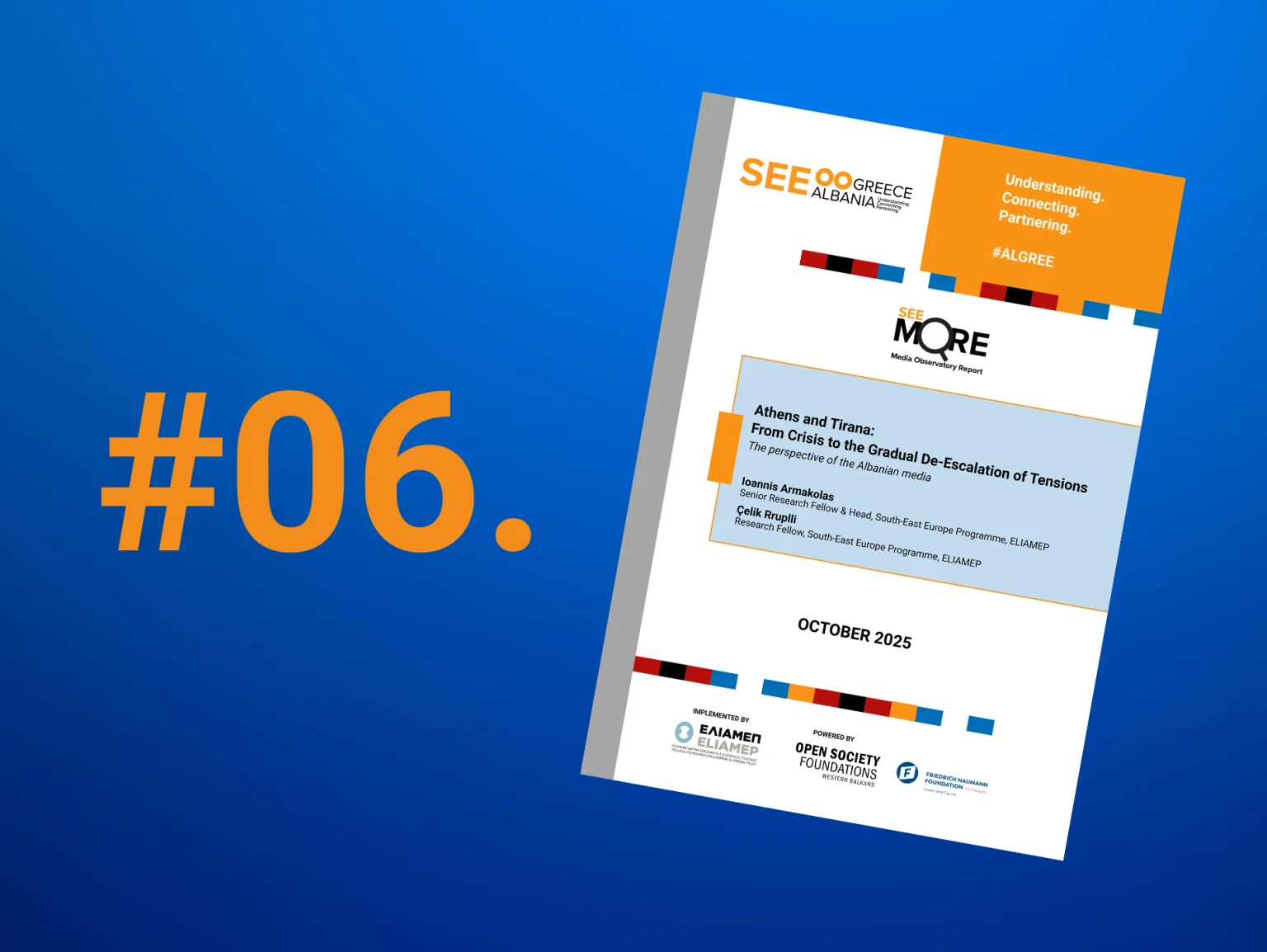

In this issue of MORE, the focus is on Greek–Albanian relations between March and October 2024, shaped by the Fredi Beleris case—a local legal dispute that evolved into a major diplomatic and media controversy. Beleris, mayor-elect of Himara, was convicted for electoral corruption but later elected to the European Parliament for Greece’s New Democracy party, intensifying tensions over democracy, minority rights, and judicial independence.
In Albania, pro-government media framed his conviction as proof of judicial reform, while opposition outlets denounced it as political persecution. In Greece, coverage was overwhelmingly sympathetic, portraying Beleris as a political prisoner. Widespread misinformation—including fake stories and manipulated images—deepened mistrust and polarization.
Tensions peaked during Beleris’s October 2024 visit to Tirana as an MEP, marked by protests and symbolic confrontation. Yet, by late 2024, relations began to improve, aided by Albania’s post-election pro-EU stance and significant progress in EU accession, with five of six negotiation clusters opened.
Covering the period from March to October 2024, MORE 6 shows how one legal case exposed the fragility of regional trust, but also how diplomatic pragmatism and the shared goal of European integration can turn confrontation into cooperation.
The Media Observatory Reports are part of the broader “ALGREE – Albania–Greece: Understanding. Connecting. Partnering” project, implemented by the South-East Europe Programme of the Hellenic Foundation for Foreign & European Policy (ELIAMEP) with support from the Open Society Foundations – Western Balkans and the Friedrich Naumann Foundation for Freedom Greece and Cyprus. Based on systematic monitoring of leading Albanian and Greek media, the reports examine how each country portrays the other and how media narratives shape mutual perceptions and shared regional agendas.
Categories:
All publications

 Experts

Ioannis Armakolas
Head of the Wider Europe Programme; Senior Research Fellow

Çelik Rruplli
Research Fellow, Wider Europe Programme, media analysis, foreign and security policies, human rights