


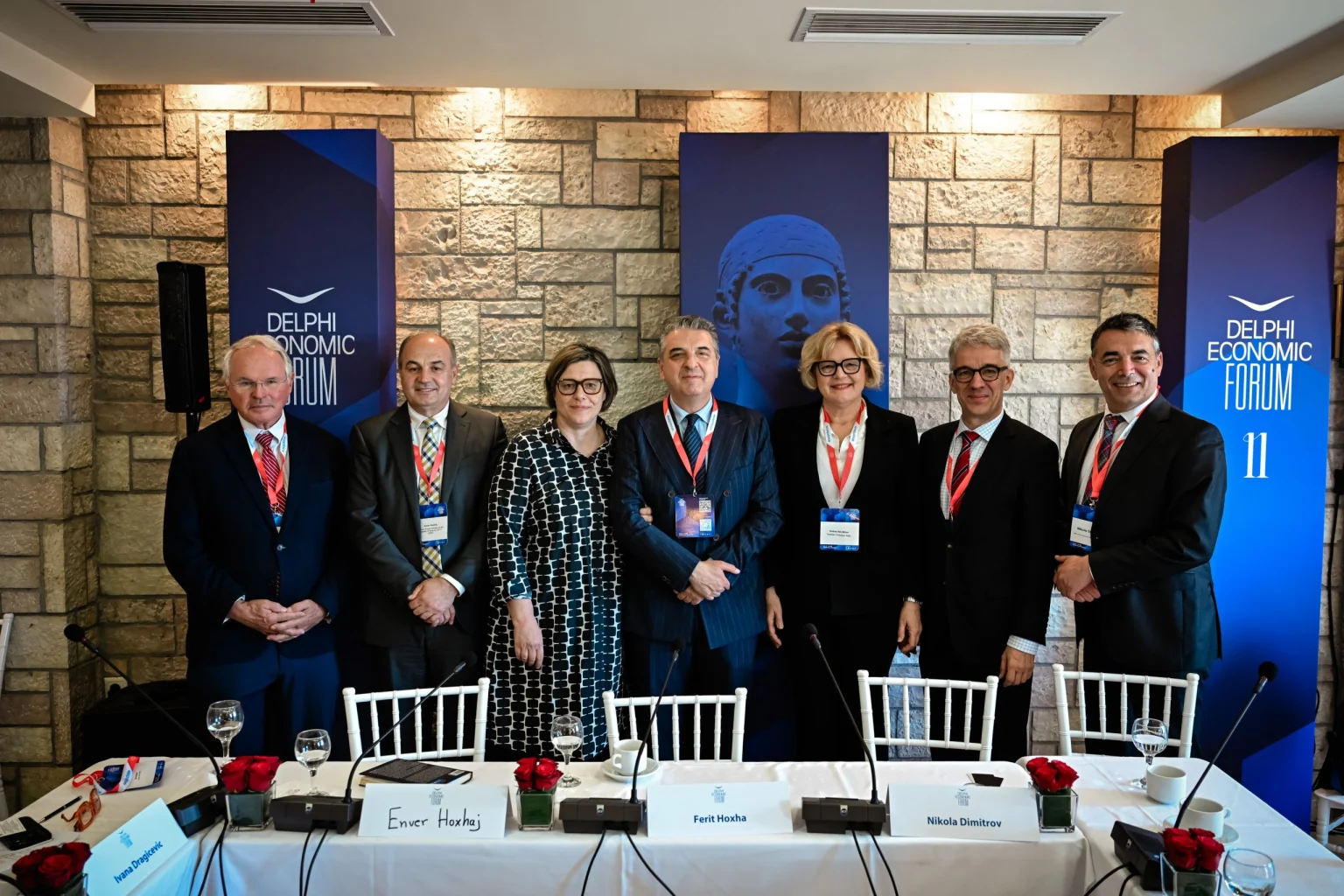

Rainer Rudolph – Ambassador of Germany to Kosovo
Christopher Hill – Former Ambassador; Fletcher School of Law and Diplomacy, United States
Nikola Dimitrov – President, SOLUTION Skopje, North Macedonia
Andrea Ikic-Böhm – Ambassador of Austria to Bulgaria
Ioannis Armakolas – ELIAMEP, Greece
Ivana Dragičević – CEO, Europe Future Centre, Croatia (CHAIR)
Dr. Ioannis Armakolas, Head of the Wider Europe Programme at ELIAMEP and Director of the think nea – New Narratives of EU Integration initiative, was among the speakers at the think nea panel discussion From Burden to Benefit: Making the Western Balkans’ EU Accession a European Geopolitical Win, held on 24 April 2026. The initiative think nea – New Narratives of EU Integration is supported by Open Society Foundations – Western Balkans.
During his intervention, Dr. Armakolas stressed that although the EU increasingly frames the next enlargement as a geopolitical one, it continues to approach the issue without the new ideas and policy tools required in a period marked by uncertainty and strategic competition. He underlined that while candidate countries must continue implementing reforms, EU member states must also make the necessary mental shift for the enlargement process to move forward effectively.
Drawing on the research findings of the think nea initiative, Dr. Armakolas highlighted several areas where the benefits of integrating the Western Balkans into the EU are particularly evident, including defence readiness, defence-industrial capacity, military mobility and logistics, as well as critical raw materials and value-chain resilience. He argued that deeper integration of the Western Balkans would provide the EU with nearby industrial scale, lower-cost production, shorter and more secure supply chains, strategic geographical advantages, and improved access to critical inputs.
At the same time, he emphasized that the EU continues to underestimate the strategic value of a region that could materially strengthen Europe’s strategic autonomy. As he noted, the Western Balkan accession is not charity; it is a strategic investment in Europe itself. He further argued that the blind spot is that Brussels still treats enlargement, defence, industrial policy, and raw materials as separate files. Strategically, they are one file.
Concluding his remarks, Dr. Armakolas stressed that a credible win-win narrative for enlargement must be accompanied by tangible benefits for the EU itself, including shorter supply chains, lower-cost production, stronger logistics, more resilience, and a more autonomous Europe.
Publication:
07/05/2026
11th Delphi Economic Forum ΧΙ
 Projects
Experts
Projects
Experts

Ioannis Armakolas
Head of the Wider Europe Programme; Senior Research Fellow