Understanding the Risks of Extremism in the Gaming Ecosystem
Gaming is one of the most popular activities among young people in Europe, and it's overwhelmingly positive. But like any social space, it can be exploited. Extremist groups increasingly exploit online communities, not because games create extremism, but because gaming ecosystems connect millions of people. This guide helps parents, educators, and young gamers understand how extremist risks can emerge and what we can all do about it.
The GEMS Guide for parents, educators, and gamers was developed by the research team of ELIAMEP within the Horizon Europe project GEMS | Gaming Ecosystem as a Multi‑layered Security Threat. It addresses a critical gap in public understanding of today’s digital gaming ecosystem, a space where millions of young people interact daily, yet where awareness of extremist exploitation risks remains limited.
Grounded in evidence‑based research conducted by the GEMS consortium, the Guide explains clearly how extremist risks can emerge within multilayered gaming and communication environments, without creating panic or stigmatizing players. Available in Greek, English, and French, it offers practical tools and balanced guidance for parents, educators, and young gamers themselves.
More specifically, the Guide helps users to:
• recognise early warning signs of problematic dynamics,
• understand how manipulation and extremist exploitation can unfold, and
• build stronger resilience against harmful behaviours and narratives.
By filling an existing gap in accessible information, the GEMS Guide supports safer, more informed participation in online gaming spaces, empowering communities to enjoy gaming while staying protected from manipulation and extremist influence.
01
Gaming is not the problem
The vast majority of gaming experiences are positive, creative, and socially meaningful. Gaming does not cause extremism.
02
Risks are layered, not sudden
Escalation rarely happens overnight. It emerges through the convergence of content, behaviour, and community dynamics.
03
Extremists adapt to gaming culture
By blending into existing communities and using humour, memes and gaming references, malicious actors can normalise toxicity, misogyny and hate speech, facilitate grooming and manipulation, promote scams and criminal exploitation.
04
Platforms, families and educators all play a role
No single actor can prevent harm alone. Resilience is a shared responsibility across institutions and communities.
05
Awareness is not restriction
The goal is informed awareness and calibrated response , not surveillance, blame, or limiting access to gaming.
06
Young people can be part of the solution
Digital literacy, ecosystem literacy, and critical thinking are the most powerful tools for building resilience.
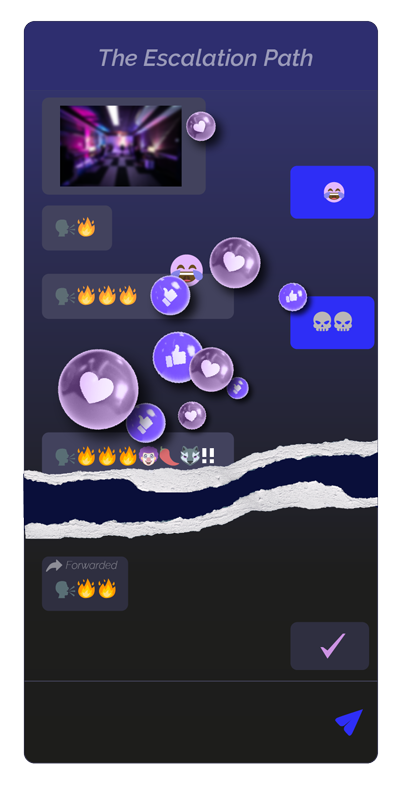
The Escalation Path
Radicalisation is rarely sudden. It follows a pattern of small steps, each of which feels normal in the moment. The same features that foster community, can also be exploited by actors who seek to normalise hate, cultivate grievance narratives and gradually guide susceptible users towards more extreme milieux.
A joke. Everyone laughs.
No one objects. Repetition.
The tone shifts. Still feels normal
Extremity performs well.
Migration. Private space.
Ideas harden. Fewer voices.
THE GUIDE
THE GUIDE
The GEMS Guide is structured into four practical parts, designed for readers who may be less familiar with the online gaming ecosystem and want a clear, evidence‑based overview. Together, these parts offer foundational knowledge, a multilayered understanding of how risks can emerge, and concrete tools to strengthen resilience.
Understanding the Online Gaming Ecosystem
How gaming became a social space, what the evidence shows, and how institutions are already responding.
Common misconceptions about gaming and radicalisation, grounded in GEMS research findings.
"If a young person plays violent video games, they are more likely to start supporting racist or authoritarian ideologies"
or
?
The correct answer is FALSE
Trigger or reflection point: Playing violent games does not cause someone to adopt racist, antisemitic, or supremacist beliefs. Identity shifts toward exclusionary worldviews usually involve repeated exposure to grievance narratives, belonging dynamics, and reinforcement within social groups — not gameplay alone.
"Supporting exclusionary or supremacist ideas usually happens suddenly."
or
?
The correct answer is FALSE
Trigger or reflection point: Adopting beliefs that minorities are inferior, that democracy is weak, or that violence is justified typically develops gradually. Repetition and normalisation lower resistance over time.
"Promoting hatred against minorities always involves direct physical violence."
or
?
The correct answer is FALSE
Trigger or reflection point: Hatred may begin with memes, slurs, conspiracy narratives, or dehumanising language. Support for violence often precedes actual violent behaviour.
"Calling someone a slur in a game is automatically the same as belonging to an extremist movement."
or
?
The correct answer is FALSE
Trigger or reflection point: Toxic insults are not automatically ideological. However, when racist, antisemitic, or anti-LGBT+ slurs become routine and unchallenged, they can make exclusionary narratives feel socially acceptable.
"Online recruitment usually starts with someone clearly asking a player to join a violent group."
or
?
The correct answer is FALSE
Trigger or reflection point: Recruitment often begins with humour, shared frustration, memes about ‘cultural decline (borders are open, culture diluted, destruction of western civilisation), ,’ or invitations to private servers — not explicit calls to join a group.
"If a young person shares memes mocking minorities but says it is ‘just irony,’ there is no concern."
or
?
The correct answer is FALSE
Trigger or reflection point: Repeated ironic sharing of antisemitic or racist memes can desensitise individuals and blur the line between humour and belief.
"A young person can begin endorsing authoritarian or exclusionary ideas without meeting anyone offline."
or
?
The correct answer is TRUE
Trigger or reflection point: Online communities can provide identity reinforcement, belonging, and repeated exposure to narratives that justify inequality or hostility.
"Most gamers regularly engage with racist or extremist communities."
or
?
The correct answer is TRUE
Trigger or reflection point: The majority of gaming content is not extremist. However, specific clusters and spikes can increase visibility.
"Complaints about ‘woke gaming’ can sometimes evolve into conspiracy narratives about minorities controlling society."
or
?
The correct answer is TRUE
Trigger or reflection point: Frustration about diversity in games can be reframed into antisemitic or anti-LGBTQ+ conspiracy narratives when exploited by extremist actors.
"A young person can reject violence but still start believing that some groups deserve fewer rights."
or
?
The correct answer is TRUE
Trigger or reflection point: Support for unequal treatment, authoritarian leadership, or minority exclusion can develop independently of violent intent.
WHO IS THIS GUIDE FOR?
A Triangle of Safety
Parents, educators, and gamers form a triangle of safety around young people in online gaming spaces. Research from the GEMS project shows that all three groups face important knowledge gaps: gamers often encounter extremist risks but rarely report them; parents and educators are not fully aware of how gaming ecosystems function or how harmful dynamics can escalate; and many are unsure how to respond when problems arise.
This Guide was created to strengthen the resilience of these three groups, and the wider community, by offering clear, accessible explanations of how risks can emerge. It provides simple, proportionate guidance on what to look out for, how to recognise early warning signs, and what actions can help keep gaming environments safe.
From understanding layered risks to building everyday resilience, the Guide encourages shared responsibility: parents and educators engaging with young people’s gaming habits, gamers recognising problematic dynamics, and all stakeholders contributing to healthier digital spaces. Whether it’s taking time to play together, encouraging open conversations, or knowing when and how to seek support, the Guide offers practical steps that help everyone stay informed and empowered.
EDUCATORS Building Awareness in Learning Spaces
GAMERS Recognising Risks in Your Community
PARENTS Your Role in Digital Resilience
Ready to level up your awareness?
Download the complete GEMS Awareness Guide — available in English.